 ETW

You have a strategy. You have probably backtested it. You know where you should enter, where your stop goes and how much you should risk. And yet, the account keeps going down for reasons that have nothing to do with the strategy: one revenge trade after a loss, a stop moved "just a little", a random entry because the market was moving and you didn't want to miss it.
That gap between what you planned and what you actually did has a name: trading discipline. This guide explains what it really is, why even good traders break their own rules, and the 7 habits that make discipline automatic instead of something you have to fight for every session.
The short version: write a one-page plan, prepare before every session, run a pre-trade checklist, risk the same small amount on every trade, set hard daily limits, journal whether you followed your rules on every trade, and review your week every Friday. Discipline is not willpower. It is a routine that removes decisions from the moment.
What trading discipline really means
Most traders think discipline means "being strong" when the market tempts them. That definition sets you up to fail, because nobody wins a fight with their own emotions 500 times in a row. Here's a more useful one:
Trading discipline is the ability to execute your trading plan the same way every time, whether you're on a winning streak, a losing streak or bored out of your mind.
Notice what that definition doesn't say. It doesn't say "win more". A disciplined trader still loses trades. The difference is that their losses are planned, small and part of a strategy with an edge, while an undisciplined trader's losses are random, often oversized and impossible to learn from.
That's also why discipline is the foundation of everything else. Your win rate, profit factor and drawdown only tell you the truth about your strategy if you actually traded the strategy. If half your trades broke the rules, your statistics are measuring your impulses, not your edge.
Why traders break their own rules
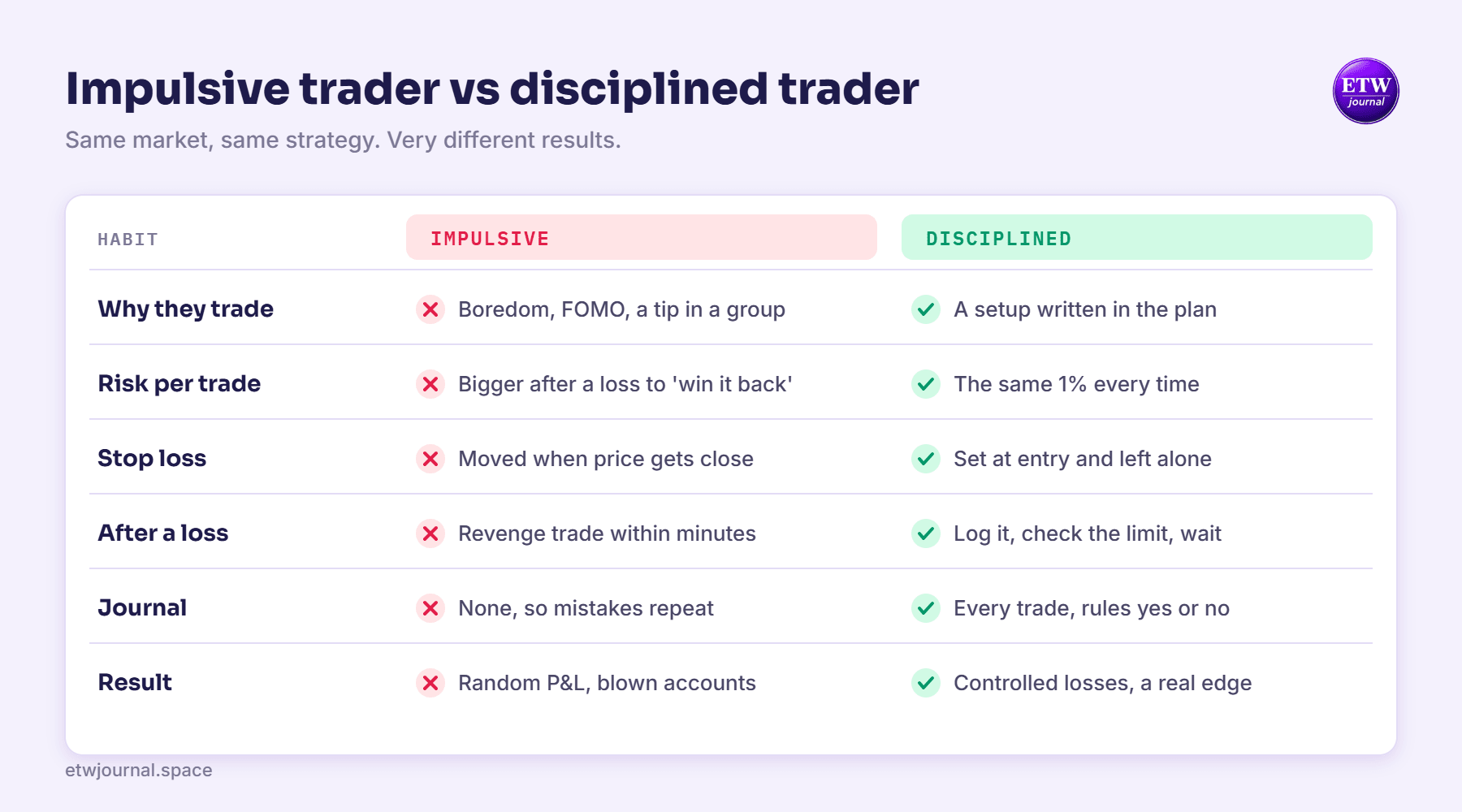
Nobody wakes up planning to revenge trade. Rule breaks happen because trading puts real money in front of the parts of the brain that hate losing and love quick rewards. These are the five most common triggers:
- Fear of missing out (FOMO): price is flying without you, so you chase an entry that isn't in your plan.
- Revenge after a loss: a loss feels personal, so you jump straight back in, often with bigger size, to "win it back".
- Overconfidence after wins: three green days in a row and suddenly the 1% rule feels too small.
- Boredom: no setup for two hours, so you start seeing setups that aren't there.
- Fear of being wrong: you move your stop further away, or close a good trade early, because you can't stand watching it go against you.

Every one of these triggers has the same weakness: it needs you to make a decision in the moment. The fix isn't to try harder. It's to make the decisions before the session starts, when you're calm, and then simply follow them.
The 7 habits of disciplined traders
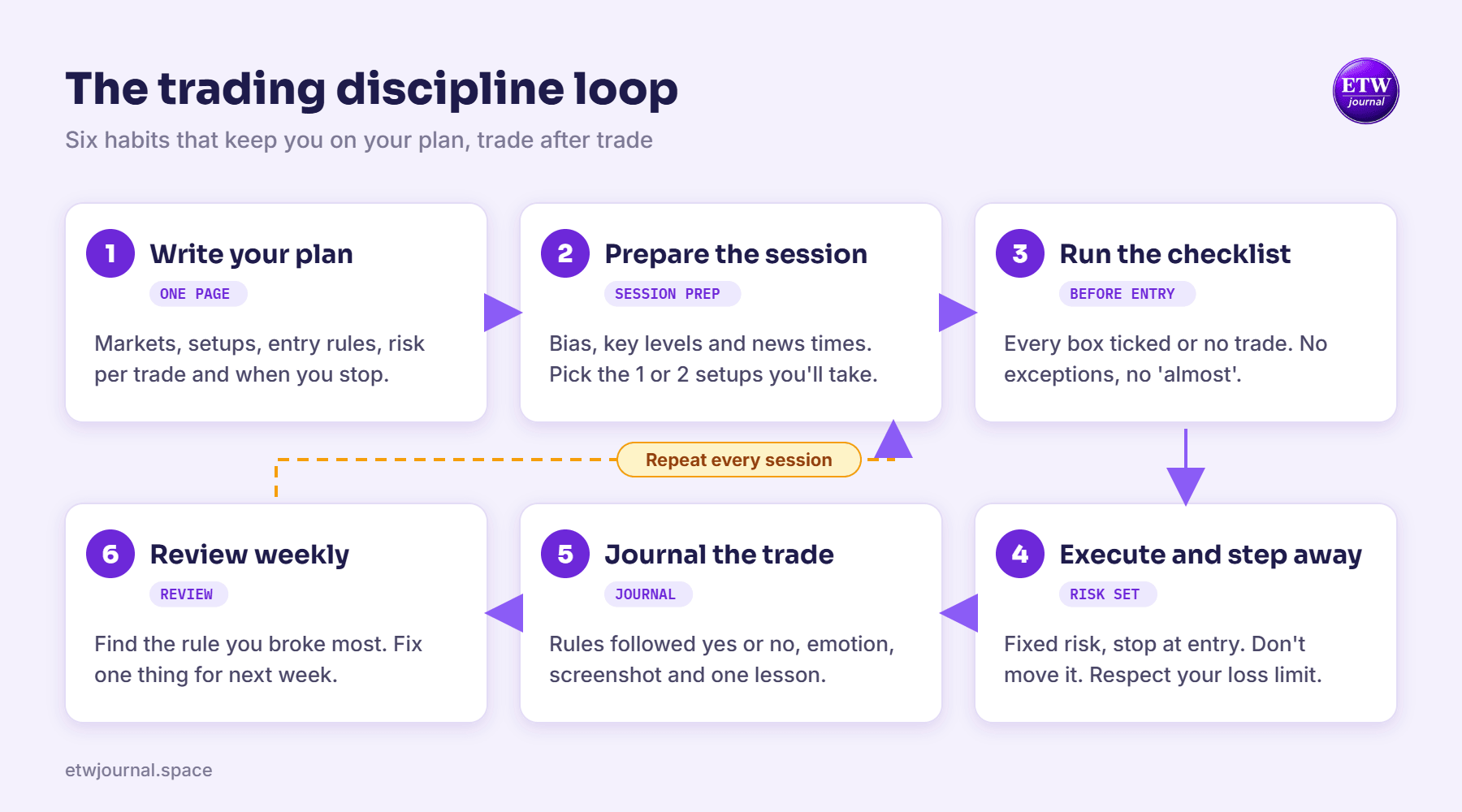
These habits work together as a loop. Plan, prepare, check, execute, journal, review and repeat. You don't need all seven on day one, but each one you add removes another chance for emotion to take over.
Habit 1: Write a one-page trading plan
You can't follow rules you never wrote down. Your plan should fit on one page and answer five questions:
- What do I trade? The 2 to 4 markets you know best, for example EURUSD, gold and NAS100.
- When do I trade? Your sessions, like London open or New York open, and when you stop for the day.
- Which setups do I take? Each setup with clear entry rules. If it isn't written here, you don't trade it.
- How much do I risk? A fixed percentage per trade, usually 0.5% to 1%. Our risk management guide shows how to calculate it.
- When do I stop? Your daily loss limit and maximum number of trades.
In ETW Journal, each setup can become a Playbook with its own rules, so every trade you log can be checked against the plan you wrote.
Habit 2: Prepare before every session
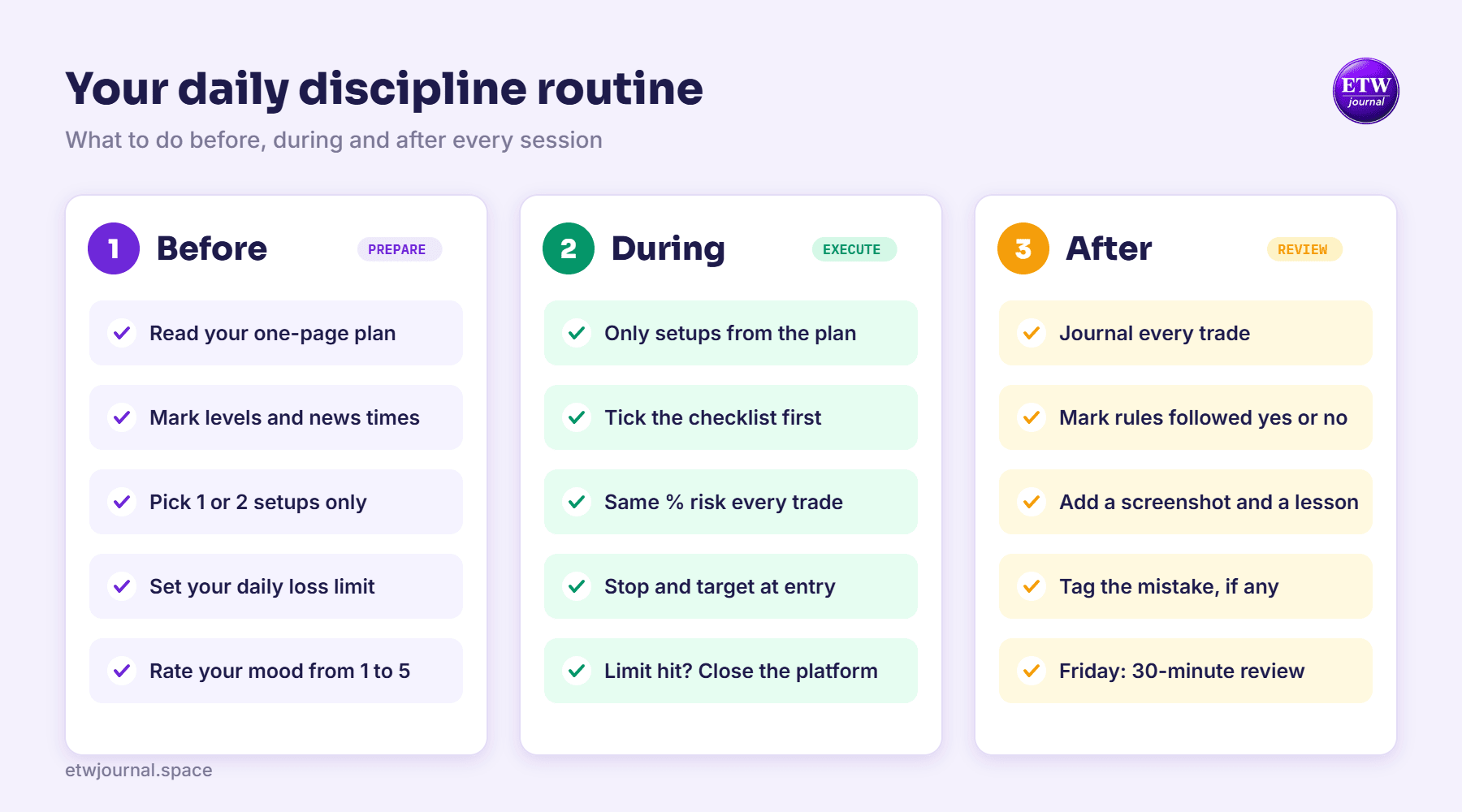
Traders who open the charts with no plan end up trading whatever moves. Spend 10 to 15 minutes before each session marking your key levels, checking the news times and writing down the one or two setups you're waiting for. Rate your mood from 1 to 5 as well. If you're a 1 or 2, trade smaller or don't trade at all.
ETW Journal's Session Prep was built for exactly this: a game plan, your bias, and an economic calendar in your own time zone, all in one place before the first candle.
Habit 3: Use a pre-trade checklist
A checklist turns a feeling ("this looks good") into a yes or no answer. Pilots use them on every flight for the same reason. Before every entry, tick each box:
- Is this setup in my plan?
- Is it in my session and away from high-impact news?
- Is my risk the planned percentage?
- Is my stop at the level that proves me wrong?
- Am I under my daily trade and loss limits?
If one box is empty, there's no trade. Not "a smaller trade". No trade.
Habit 4: Risk the same small amount every time
Nothing breaks discipline faster than a big position. When one trade can ruin your week, every tick feels like a threat, and you start moving stops and closing early. Fixed risk, like 1% per trade, keeps every single trade emotionally small. Losing 1% is annoying. Losing 10% makes people do things they regret.
Habit 5: Set hard limits and walk away
Decide in advance when your day is over: for example, after 3 trades, after 2 losses in a row or after a 2% daily loss. When you hit the limit, close the platform. Not minimize it. Close it.
This one rule stops most revenge trading, because the moment you're most likely to break your rules is right after a loss. If you trade a prop firm account, your own daily limit should sit well inside the firm's, and Prop Firm Sync helps you see how close you are to its rules.
Habit 6: Journal every trade, including whether you followed the rules
Your journal is where discipline becomes measurable. For every trade, record more than the P&L: which setup it was, whether every rule was followed, how you felt before entry and one lesson. Add a screenshot. It takes two minutes once your trades sync automatically.

The most important field is the simplest one: rules followed, yes or no. After a month, it shows you exactly how much your rule breaks cost. If you haven't set up your journal yet, our step-by-step journaling guide walks you through it.
Habit 7: Review your week every Friday
A journal you never read is just a diary. Once a week, spend 30 minutes looking for patterns: Which rule did you break most? On which day or session? After what kind of trade? Then pick one thing to fix next week. Not five. One.
ETW Journal's weekly review routine covers this step by step, and the Discipline PnL Calendar scores each day on process, so you can see your discipline improve even in weeks when the P&L doesn't.
Judge the process, not the result
Here's the mindset shift that makes discipline stick. A trade isn't good because it made money, and it isn't bad because it lost. It's good if you followed your plan.
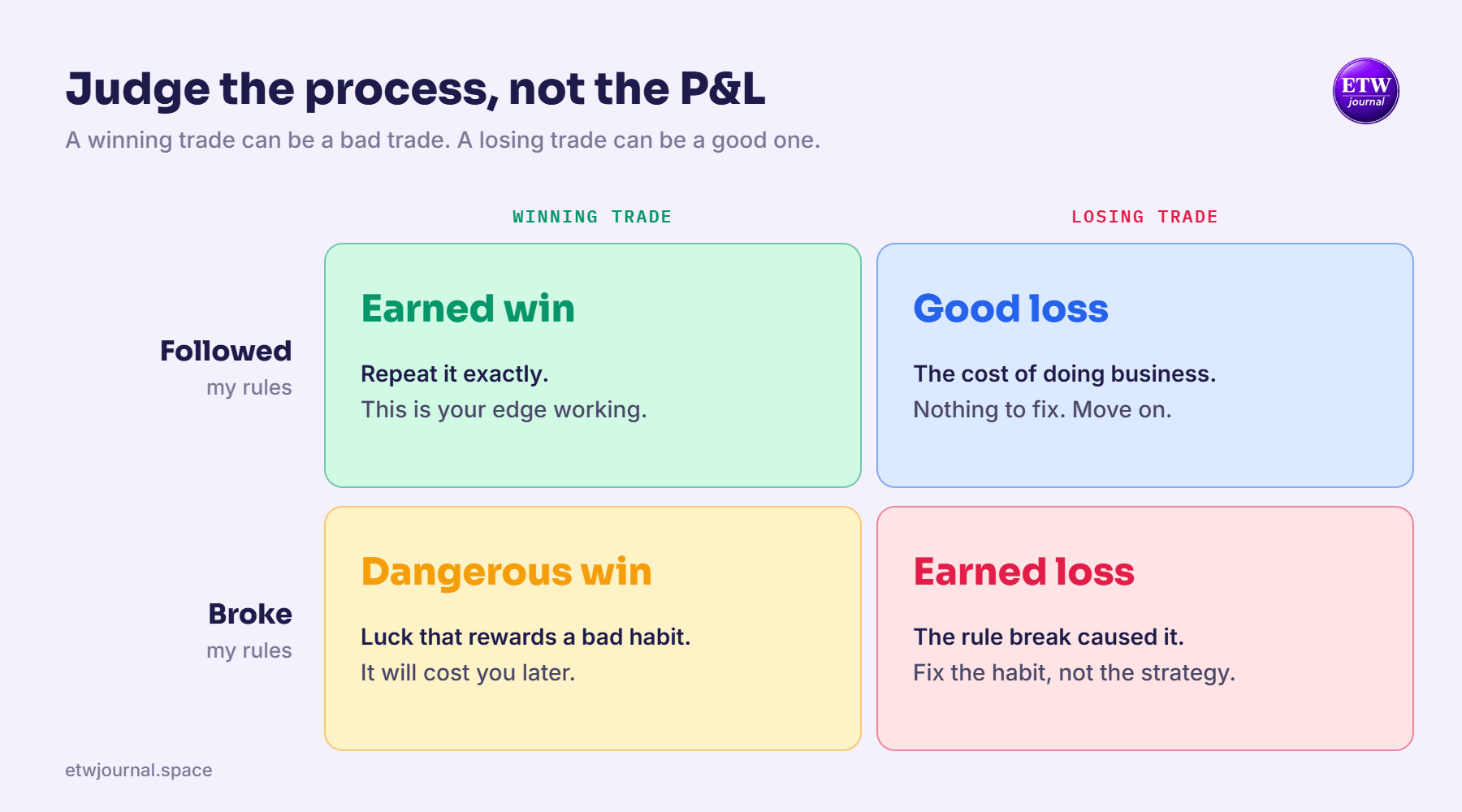
The most dangerous box is the dangerous win: a trade that broke your rules and made money anyway. It teaches your brain that breaking rules pays, and that lesson usually costs far more than the trade made. When you review your trades, treat these wins as mistakes.
Tip: tag every rule-break trade in ETW Journal with the rule you broke, like Moved stop, FOMO entry or Over risk. After 30 trades, your tag reports show exactly which habit is costing you the most money. Here's how to use tags.
What to do right after you break a rule
You will break rules. Every trader does. What matters is the next five minutes:
- Stop trading for the session. One rule break often leads to another.
- Journal it honestly. What happened, what you felt, and which rule you broke.
- Find the trigger. Was it a loss, boredom, a big move or something outside trading?
- Add a rule that blocks it next time. For example: "After 2 losses I stop for the day."
- Forgive it and move on. Beating yourself up leads to more emotional trading, not less.

A 30-day discipline challenge
Want to build the habit fast? Try this for one month:
- Week 1: write your one-page plan and journal every trade with "rules followed: yes or no".
- Week 2: add Session Prep before every session and a hard daily loss limit.
- Week 3: use the pre-trade checklist on every entry and tag every rule break.
- Week 4: run a full weekly review and compare the P&L of rule-following trades vs rule-break trades.
Most traders find that their rule-following trades are profitable and their rule breaks are where almost all the damage comes from. Once you see that in your own numbers, discipline stops feeling like a sacrifice.
Frequently asked questions
What is trading discipline?
Trading discipline is following your trading plan the same way on every trade: only taking planned setups, risking a fixed amount, respecting your stop loss and your daily limits, and reviewing your results honestly.
How do I stop revenge trading?
Set a hard rule before the session, such as stopping after 2 losses in a row or a 2% daily loss, and close your platform when you hit it. Journal the loss before you're allowed to look at the charts again.
Can trading discipline be learned?
Yes. Discipline is mostly a set of habits and routines: a written plan, a checklist, fixed risk, limits and a journal. Each one removes a decision from the moment, so you need less willpower over time.
How long does it take to become a disciplined trader?
Most traders see a real change within 30 to 90 days of journaling every trade and reviewing weekly. The key is measuring rule-following, not just P&L, so you can see progress.
Start measuring your discipline
You can't improve what you don't measure. Open ETW Journal, connect your broker so your trades sync automatically, and start logging whether you followed your rules on every trade. In a month, your journal will show you exactly which habits are making you money and which ones are costing you.
And once your discipline is in place, make sure your risk is too. Read our guide to risk management, the 1% rule and position sizing next.
Risk warning: trading forex, indices, commodities and crypto carries a high risk of loss. This article is for education only and is not financial advice. No routine or tool can guarantee profits.