 ETW

Ask a trader who blew an account what went wrong, and they'll usually blame the strategy, the market or the broker. Look at their trades and the real cause is almost always the same: one or two trades that were far too big. The strategy didn't kill the account. The risk did.
Risk management is the least exciting part of trading and the most important. It decides whether a bad week costs you 4% or 40%, and whether you're still trading next year. This guide covers the maths of losses, the 1% rule, exactly how to calculate your position size on forex, gold and futures, and the limits that protect your account when things go wrong.
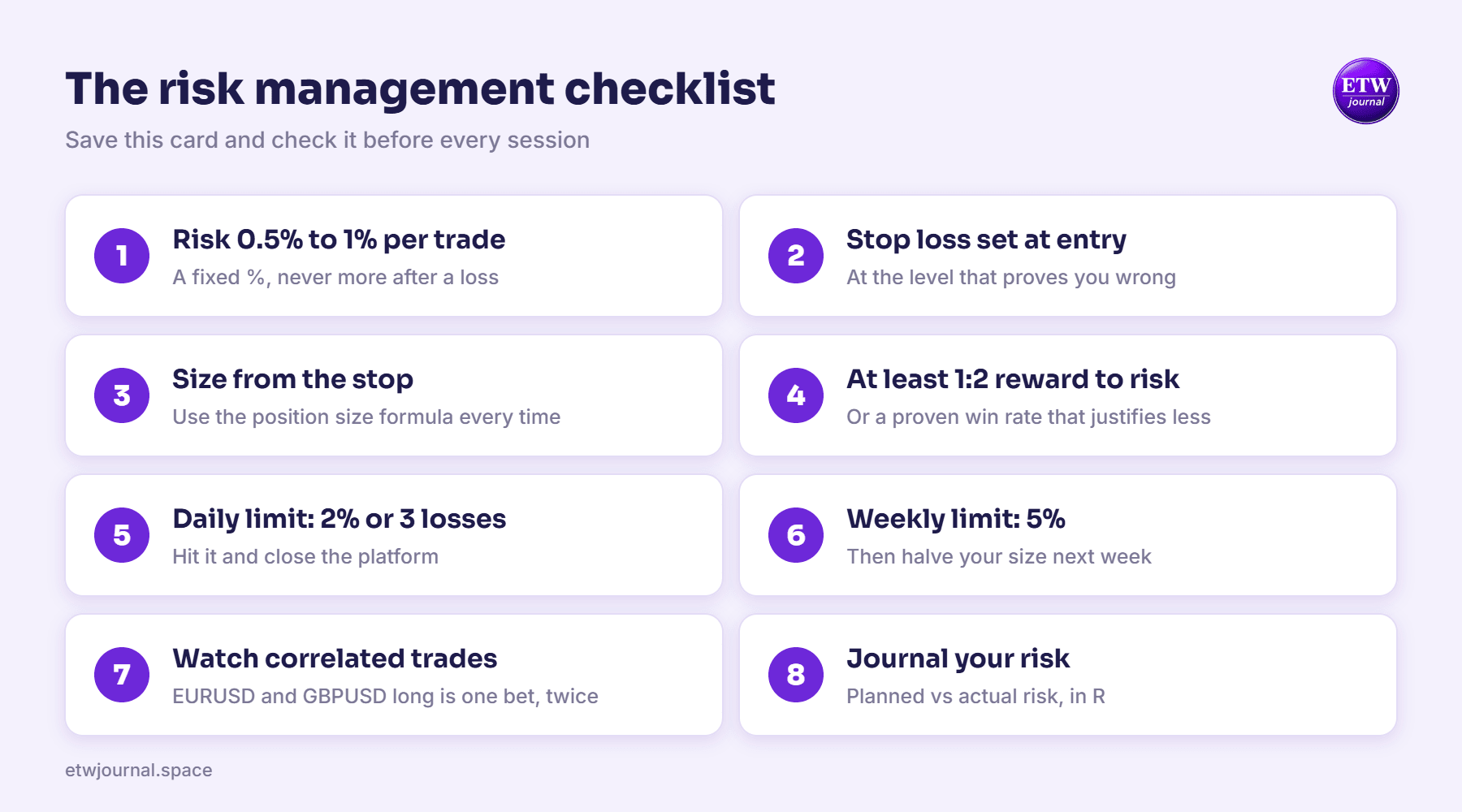
The short version: risk 0.5% to 1% of your account per trade, calculate your lot size from your stop loss every time, aim for at least 1:2 reward to risk, stop for the day after a 2% loss, and track your planned vs actual risk in your journal.
What is risk management in trading?
Risk management is deciding, before you enter, how much you're willing to lose on a trade, a day and a week, and sizing every position so you can never lose more than that.
It has three parts. Risk per trade controls how much one loss can hurt. Position sizing turns that risk into a lot size. Loss limits stop a bad day from turning into a blown account. Get these three right and even an average strategy can survive long enough to improve.
The maths of losing: why big losses are so dangerous
Losses and gains are not symmetrical. If you lose 10%, you need 11.1% to get back to breakeven. That's fine. But if you lose 50%, you need a 100% gain just to get back to where you started. Lose 90% and you need +900%.
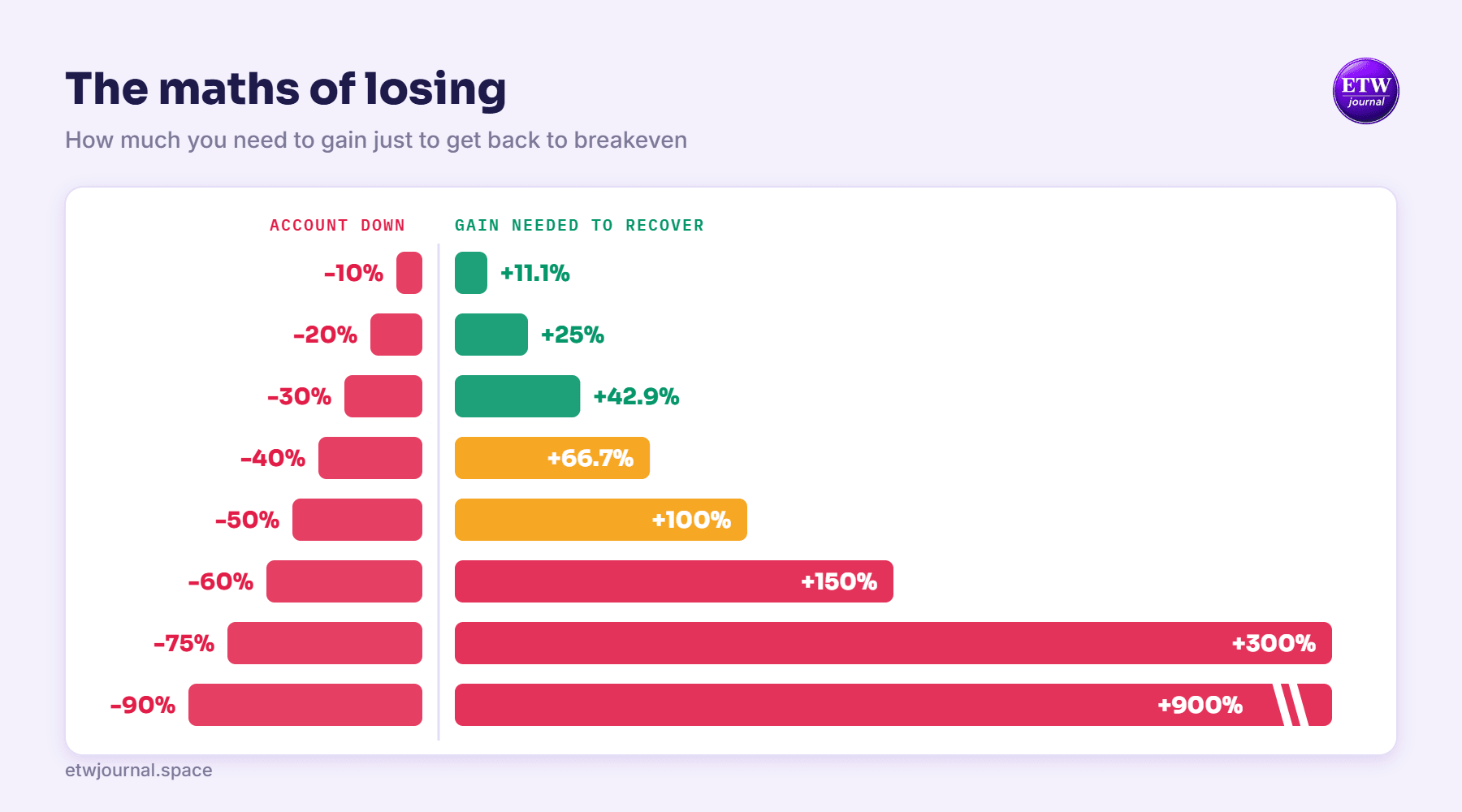
The formula is simple: gain needed = loss ÷ (1 − loss). A 30% drawdown needs 0.30 ÷ 0.70 = 42.9%. This is why professional traders obsess over keeping drawdowns small. Protecting capital comes first, because you can't compound money you no longer have.
The 1% rule: how much to risk per trade
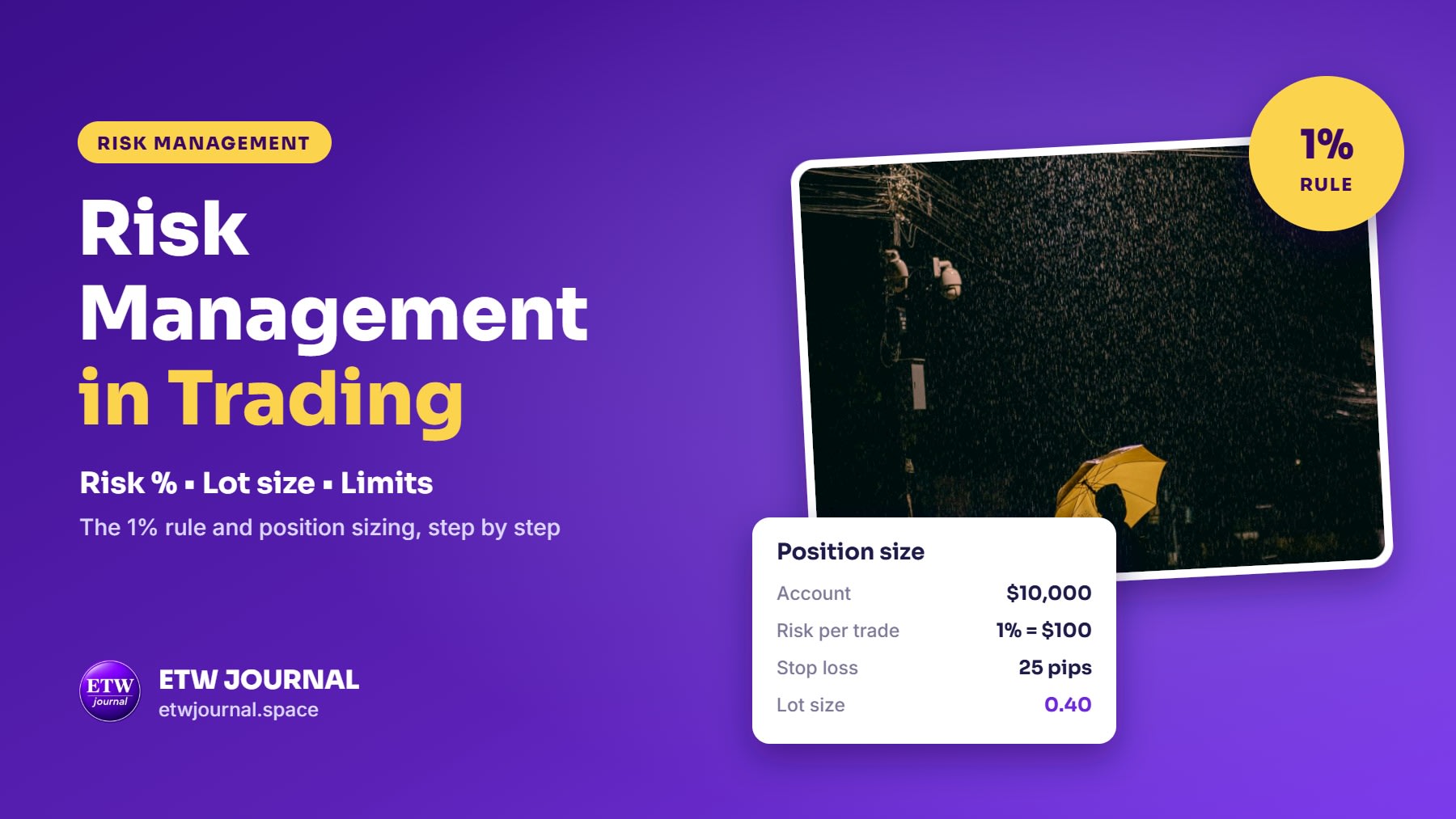
The 1% rule says you should never risk more than 1% of your account on a single trade. On a $10,000 account, that's $100. Many professionals risk even less, around 0.25% to 0.5%, especially on prop firm accounts with tight drawdown rules.
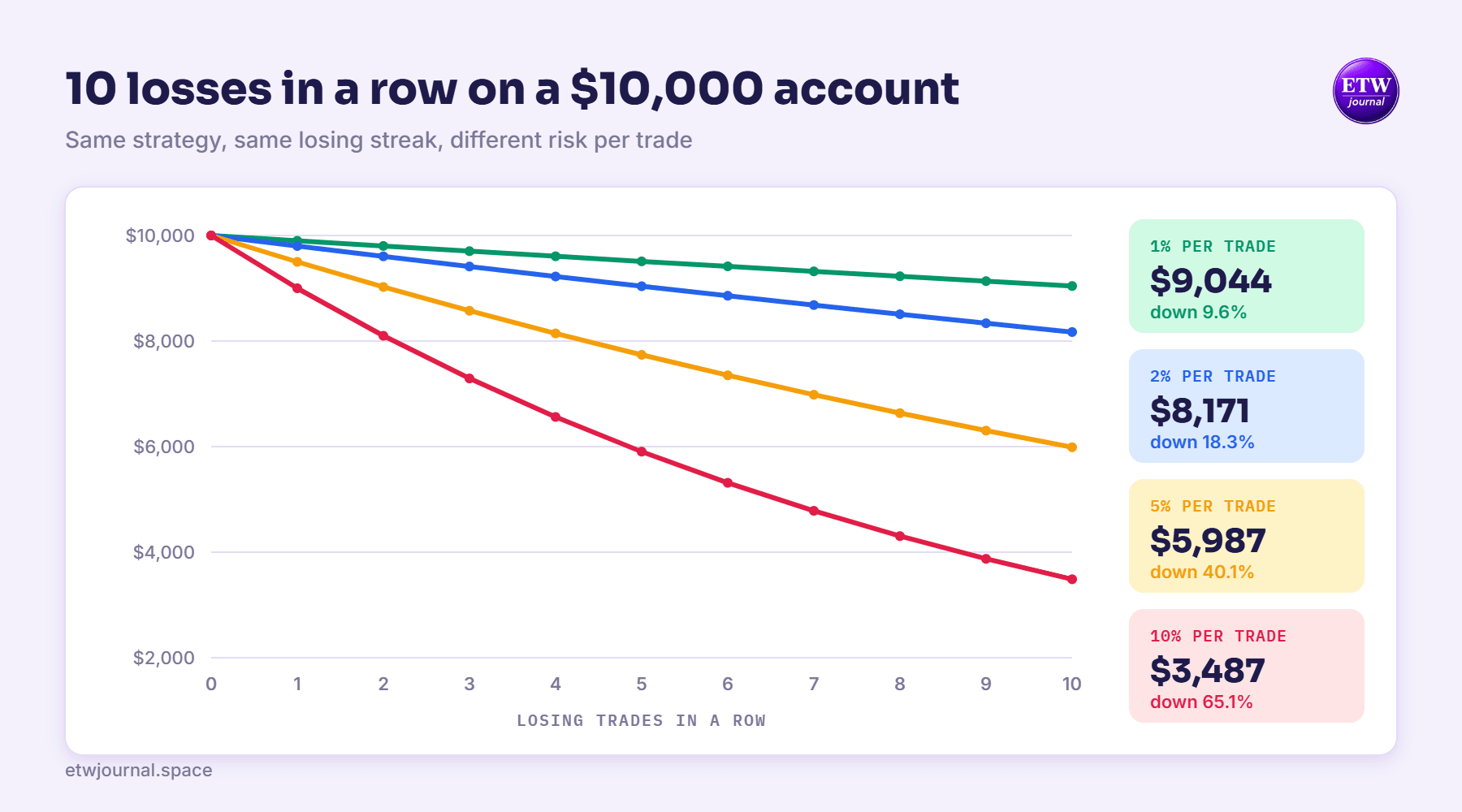
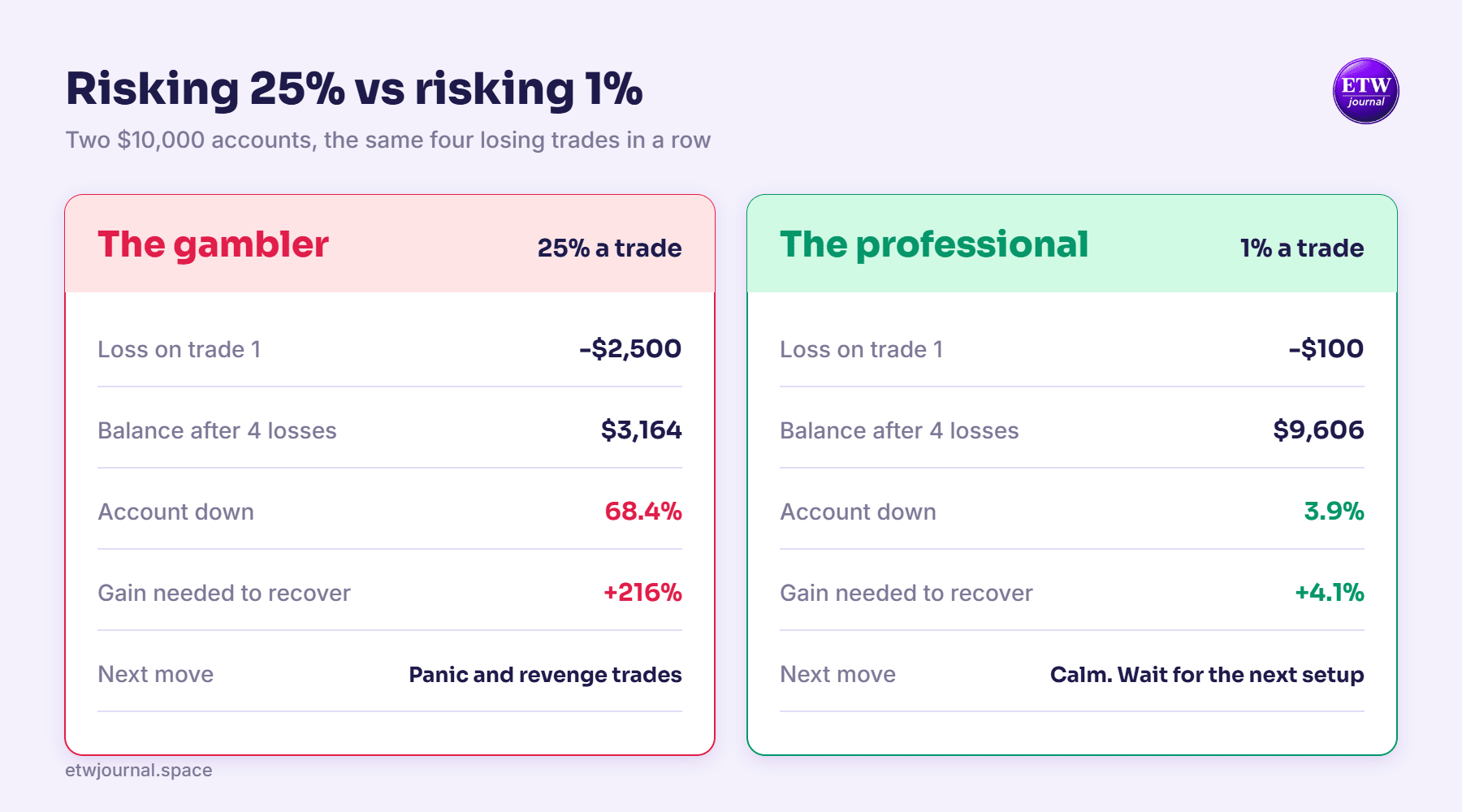
Why so small? Because losing streaks are normal. Even a strategy that wins 50% of the time will hit 6, 8 or 10 losses in a row at some point over a few hundred trades. Here's what the same 10-loss streak does at different risk levels:
| Risk per trade | Balance after 10 losses | Account down | Gain needed to recover |
|---|---|---|---|
| 1% | $9,044 | 9.6% | +10.6% |
| 2% | $8,171 | 18.3% | +22.4% |
| 5% | $5,987 | 40.1% | +67.0% |
| 10% | $3,487 | 65.1% | +186.8% |
Small risk also helps your psychology. When a loss only costs 1%, it's easy to accept it and wait for the next setup. When a loss costs 10%, you panic, and panic leads to revenge trades. Our guide to trading discipline goes deeper into that side of it.
How to calculate your position size
This is where most traders go wrong. They pick a lot size that "feels right", like always trading 1 lot, and then place their stop wherever it fits. That means their real risk changes on every trade. Do it the other way around: place your stop where the trade is proven wrong, then calculate the size.
Position size = Money at risk ÷ (Stop distance × Value per pip or point)
Money at risk is your account balance multiplied by your risk percentage. Here are three worked examples on a $10,000 account risking 1% ($100):
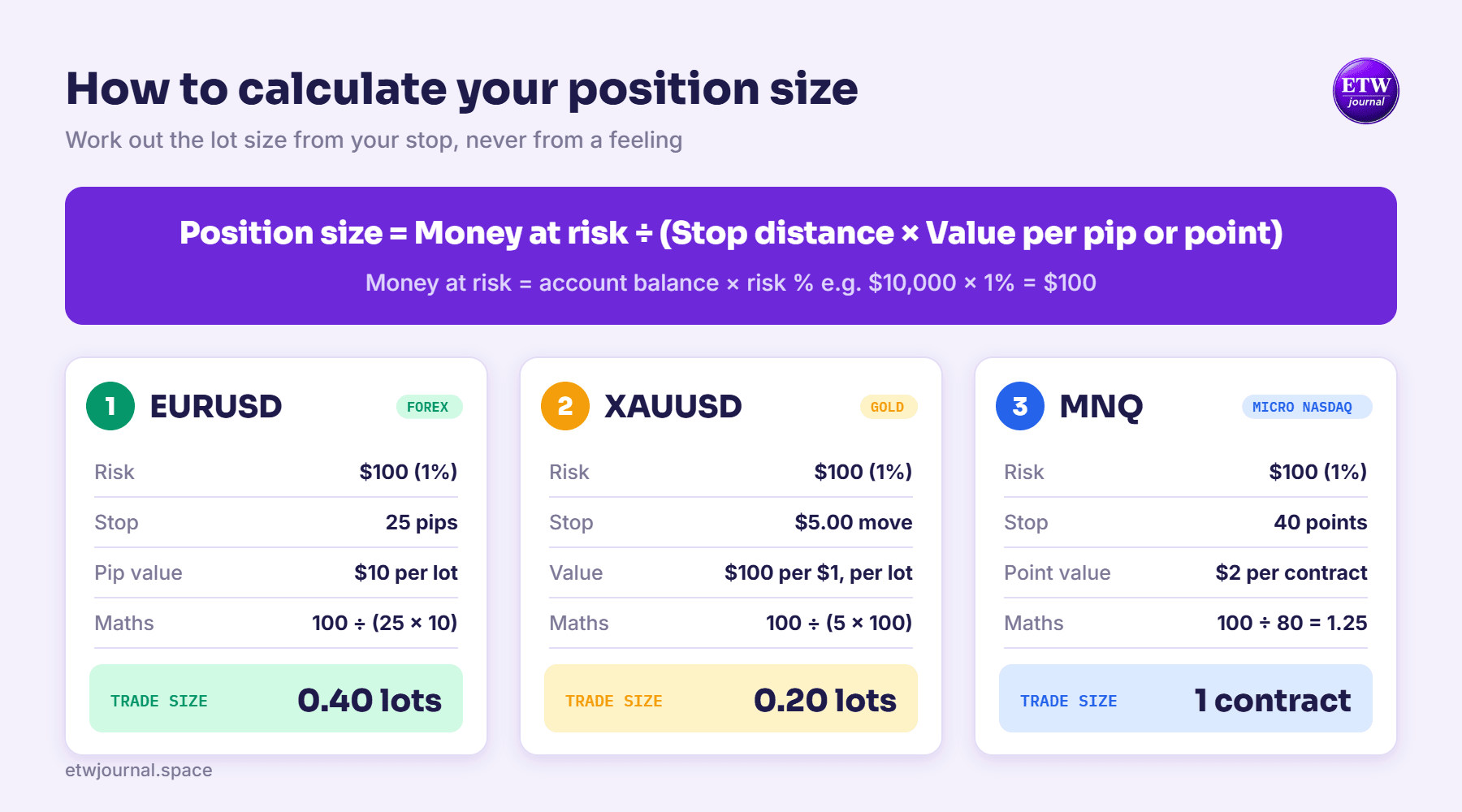
- EURUSD (forex): stop of 25 pips, pip value $10 per standard lot. 100 ÷ (25 × 10) = 0.40 lots.
- XAUUSD (gold): stop of $5.00, and 1 lot (100 oz) moves $100 per $1. 100 ÷ (5 × 100) = 0.20 lots.
- MNQ (Micro Nasdaq futures): stop of 40 points at $2 per point. 100 ÷ 80 = 1.25, so you round down to 1 contract and risk $80.
Always round down, never up. And check your broker's contract specifications, because pip and point values can differ between brokers, account currencies and instruments.

Where to put your stop loss
Your stop loss should sit at the price that proves your trade idea wrong, not at a random dollar amount. For a long trade, that's usually below the swing low or the zone you're trading from. For a short, above the swing high. Then let the position size absorb the distance: a wider stop means a smaller size, so your dollar risk stays the same.
Three stop loss rules worth writing into your plan:
- The stop goes in at entry. Not "in a minute". At entry.
- Never widen it. You can move it closer to lock in profit, but never further away.
- Leave room for normal noise. A stop placed exactly on a swing point often gets swept. Give it a small buffer.
Reward to risk and win rate
Risk management isn't only about losses. It's about making sure your winners pay for your losers. Your reward to risk ratio (R:R) and your win rate work together:
| Reward to risk | Win rate needed to break even |
|---|---|
| 1:1 | 50% |
| 1:1.5 | 40% |
| 1:2 | 33.3% |
| 1:3 | 25% |
The breakeven win rate is 1 ÷ (1 + R). At 1:2, you only need to win one trade in three to break even. That's why many traders aim for at least 1:2. A strategy that wins 40% of the time at 1:2 has a positive expectancy: (0.40 × 2) − (0.60 × 1) = +0.2R per trade. Over 100 trades at $100 risk, that's around $2,000.
Daily and weekly loss limits
Risk per trade protects you from one bad trade. Loss limits protect you from one bad day. A common set of limits looks like this:
- Daily limit: stop after a 2% loss or 3 losing trades, whichever comes first.
- Weekly limit: stop after a 5% loss, and trade half size the following week.
- Monthly limit: after a 10% drawdown, stop live trading and go back to backtesting and review.
If you trade prop firm challenges, your limits must sit well inside the firm's daily and maximum drawdown rules, not right on them. Our prop firm playbook breaks down the risk maths for FTMO, FundedNext, FundingPips and Maven.
Watch correlated trades. Buying EURUSD and GBPUSD at the same time isn't two trades at 1% each. Both pairs usually move together against the dollar, so it's closer to one trade at 2%. The same goes for NAS100 and US500. Count correlated positions as one when you add up your risk.

Leverage is not the same as risk
Many new traders think high leverage is dangerous by itself. It isn't. Leverage only decides how much margin you need to open a position. Your real risk is decided by your position size and your stop loss. A trader with 1:500 leverage who risks 1% per trade with a stop is far safer than a trader with 1:30 leverage who opens a full-size position with no stop. Use leverage as a tool, and let your risk percentage set the size.
The risk management checklist
Track your risk in your journal
The rules above only work if you follow them, and the only way to know is to measure. For every trade, your journal should show your planned risk and your actual result in R. If your average loss is -1.6R instead of -1R, you're moving stops or sizing wrong, and you'll see it within a few weeks.
In ETW Journal, trades sync automatically from your broker, so your real size, stop and P&L are already there. Tag oversized trades with Over risk and check your reports to see what they cost you. Our guide on how to journal your trades shows the full routine, and Prop Firm Sync checks each trade against your firm's drawdown rules for you.
Frequently asked questions
What is the 1% rule in trading?
The 1% rule means never risking more than 1% of your account balance on a single trade. On a $10,000 account, your maximum loss per trade is $100, so even 10 losses in a row leave you down less than 10%.
How do I calculate lot size?
Divide the money you're risking by your stop distance multiplied by the value per pip or point. For example, $100 ÷ (25 pips × $10 per pip) = 0.40 lots on EURUSD.
What is a good risk to reward ratio?
Many traders aim for at least 1:2, which only needs a win rate above 33.3% to be profitable. A lower ratio can still work if your journal proves a high enough win rate.
How much should I risk on a prop firm account?
Most funded traders risk 0.25% to 1% per trade, and keep their own daily loss limit well inside the firm's daily drawdown rule so one bad day can't fail the account.
Protect the account first
You don't need a perfect strategy to make money trading. You need a decent edge and the survival skills to keep trading it through the losing streaks. That's what risk management gives you. Risk small, size from your stop, respect your limits and journal every trade, and the maths starts working for you instead of against you.
Risk warning: trading forex, indices, commodities and crypto carries a high risk of loss, and you can lose more than you expect. This article is for education only and is not financial advice. Check your broker's contract specifications before you trade.