 ETW

Every month, thousands of traders buy a prop firm challenge, trade it hard for a week and lose it. Most of them don't fail because their strategy is bad. They fail because they treat a risk-management test like a profit race.
This guide is the playbook we wish every trader read before paying their first challenge fee. We'll cover how prop firms really work, the rules that kill most accounts, the risk maths that passes challenges, and a firm-by-firm breakdown of four of the most popular firms in our community: FTMO, FundedNext, FundingPips and Maven Trading.
What a prop firm actually is
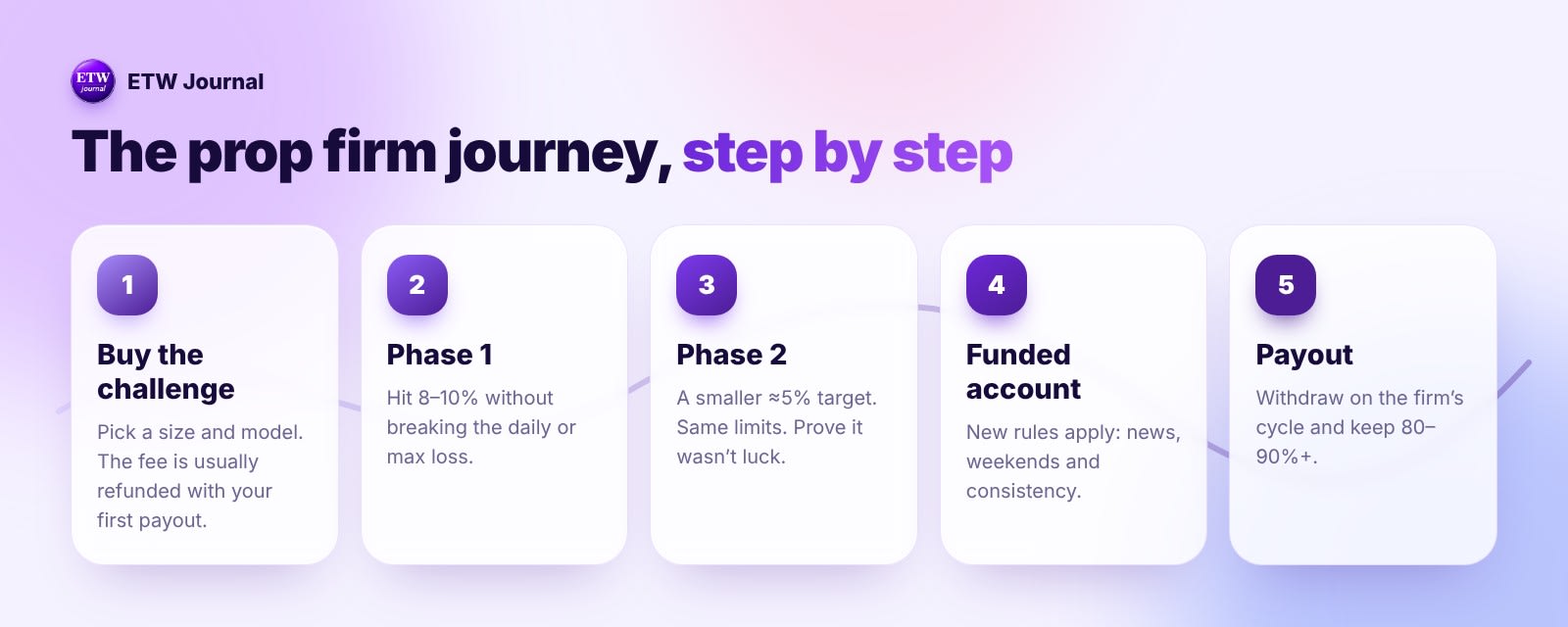
A proprietary ("prop") trading firm offers you access to a large account, typically $5,000 to $200,000, in exchange for a one-time evaluation fee. You prove you can make a target without breaking the risk rules. If you pass, you get a funded account and keep most of the profit, usually 80–90%.
Two things to understand from day one:
- Most funded accounts are simulated. Your trades are usually not sent to a real market. The firm pays you out of its own revenue, and may copy strong traders into real positions.
- Fees are a big part of the business. Most traders fail, and their fees pay for the payouts of those who pass. That isn't a scam on its own, but it means the rules are designed to filter out undisciplined trading. Your job is to be the trader they can't filter out.
Challenge models explained
Firms now sell several kinds of evaluation. The model matters as much as the firm, because each one rewards a different trading style.
| Model | How it works | Typical rules | Best for |
|---|---|---|---|
| 2-Step | Two phases, then funded | 8–10% then 5% target, 5% daily, 10% static max loss | Most traders. The most room for error. |
| 1-Step | One phase, then funded | 8–12% target, ~3% daily, tighter or trailing max loss | Traders with a proven, low-drawdown system |
| 3-Step | Three small phases | ~3% target per phase, 2% daily, 3% max loss | Very patient, low-risk scalpers |
| Instant / Zero | Funded from day one, no evaluation | No target, tight trailing drawdown, consistency rules, higher fee | Experienced traders who want to skip the test |
Our default recommendation for most traders is a 2-Step with a static max loss. It has the lowest pressure per phase and the most forgiving drawdown, and its rules are the easiest to plan around.
The rules that kill accounts
You can't break a rule you understand. Read the rules page of your firm line by line before your first trade, because these are the ones that end most challenges:
| Rule | What it means | How traders break it |
|---|---|---|
| Daily loss limit | Max loss in one day, usually 3–5% of the starting balance | Revenge trading after two losses; floating losses on open trades count too |
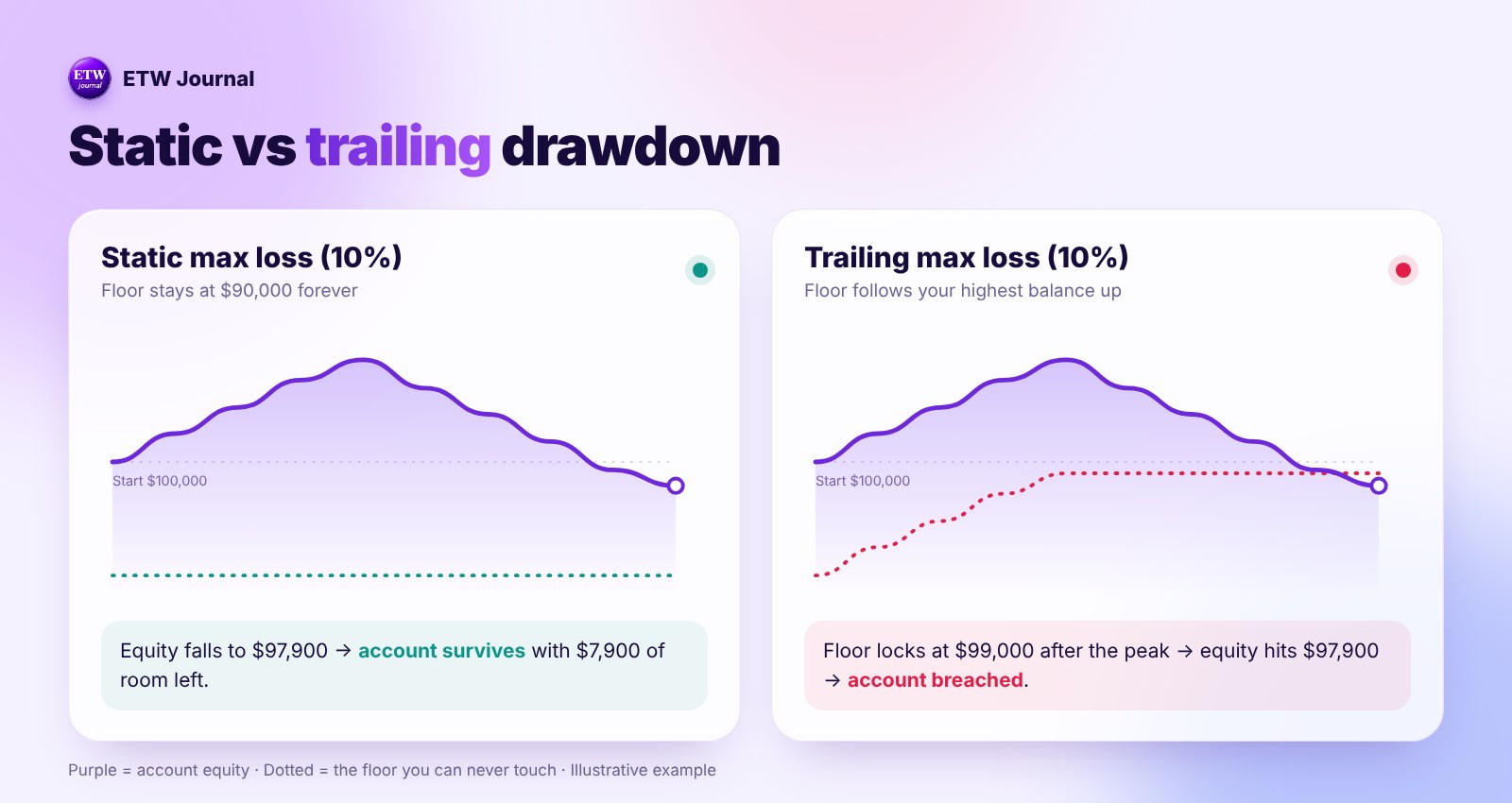
| Max loss (static) | A fixed floor, e.g. $90,000 on a $100K account | Slow bleed from oversized risk |
| Max loss (trailing) | The floor moves up as your balance or equity peaks | Giving back open profit after a good run |
| Minimum trading days | You must trade on a set number of separate days | Over-trading to "finish" the days |
| Consistency rule | Your best day can't be too large a share of total profit | One huge day, then nothing; payout gets blocked |
| News & weekend rules | Funded accounts often ban trading around high-impact news or holding over the weekend | Forgetting a position before NFP or Friday's close |
| Prohibited strategies | Latency arbitrage, tick scalping, account-sharing and copy-trading abuse | Buying "passing EAs" or letting someone else trade |
The big four, side by side
These are four of the most widely used firms among ETW Journal traders. Here's how their standard 2-Step challenges compare as of October 2026.
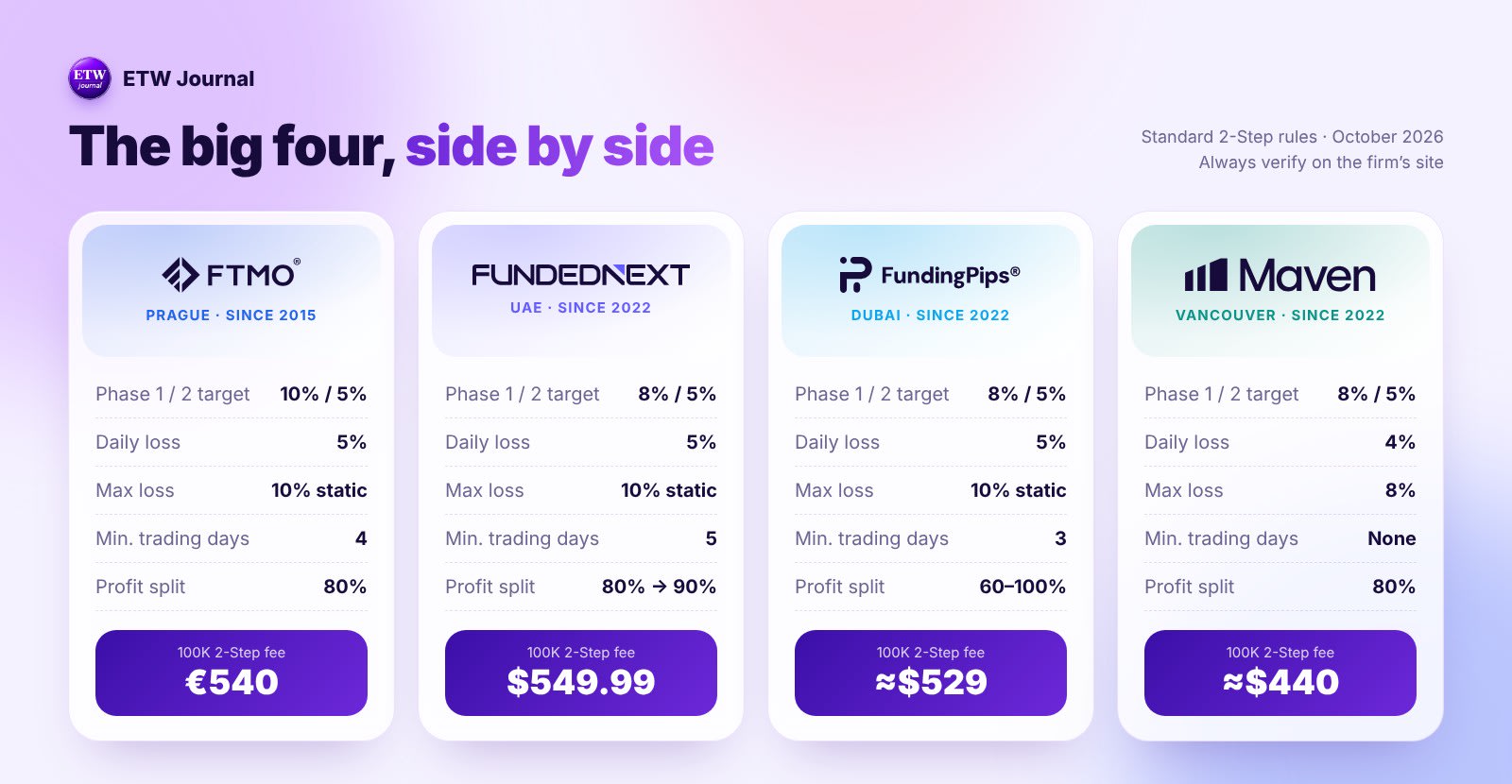
| FTMO | FundedNext (Stellar) | FundingPips | Maven | |
|---|---|---|---|---|
| Phase 1 / 2 target | 10% / 5% | 8% / 5% | 8% / 5% | 8% / 5% |
| Daily loss | 5% | 5% | 5% | 4% |
| Max loss | 10% static | 10% static | 10% static | 8% |
| Min. trading days | 4 | 5 per phase | 3 | None |
| Time limit | None | None | None | None |
| Funded profit split | 80% | 80%, up to 90–95% | 60–100% by payout cycle | 80% |
| Payouts | Every 14 days | 21 days first, then 14 (on-demand options) | Weekly, bi-weekly, monthly or on-demand | Regular short cycles |
| 100K fee (approx.) | €540 | $549.99 | ~$529 | ~$440 |
Rules and prices change often and promotions are constant. Always confirm on the firm's official site before you buy.
FTMO: the benchmark
Founded in Prague in 2015, FTMO is the firm most others copied. Its 2-Step asks for a 10% Phase 1 target, the highest of the four, but gives you a static 10% max loss and a 5% daily limit. The fee is refunded with your first reward. FTMO also offers a 1-Step (10% target, 3% daily, 10% trailing end-of-day max loss, 90% split, and a "best day" consistency rule) and instant funding.
- Best for: traders who value reputation and a long payout record over the cheapest fee.
- Watch out for: on funded standard accounts you can't trade restricted news in the 2 minutes either side of the release, and you must close before the weekend (Swing accounts remove both).
FundedNext: most payout flexibility
FundedNext's Stellar 2-Step uses an 8% then 5% target, 5% daily and 10% max loss, with at least five trading days per phase. Two features stand out: a 15% reward on the profits you made during the challenge (paid once you reach scale-up criteria) and a choice of payout styles: a 21-day cycle at 80%, an on-demand option at 90%, or a "3 profitable days" option at 60%.
- Best for: traders who want to choose how often they get paid.
- Watch out for: the Quick Strike rule (trades closed within 30 seconds must stay under 30% of your trades), and the payout option you pick at checkout can't be changed later.
FundingPips: the most model choice
FundingPips offers a 2-Step Standard (8% / 5%, 5% daily, 10% max), a cheaper 2-Step Pro (6% / 6%, 3% daily, 6% max), a 1-Step and an instant Zero account. On the 2-Step Standard, your profit split depends on the payout cycle you choose, from more frequent payouts at a lower split to monthly payouts at up to 100%.
- Best for: budget-conscious traders and those who want to pick a model to match their style.
- Watch out for: deliberate news trading is prohibited on funded accounts, with restricted windows around high-impact events, and some payout options carry a best-day consistency rule.
Maven Trading: low entry price, tighter limits
Vancouver-based Maven is popular for its low fees and small account sizes, starting around $2,000. Its 2-Step uses 8% / 5% targets but a tighter 4% daily and 8% max loss, with no minimum trading days. It also offers 1-Step, 3-Step and instant accounts.
- Best for: newer traders who want to practise under real rules for a low fee.
- Watch out for: the tighter drawdown, plus a consistency score for payouts (largest winning day relative to total profit) that punishes one big day.
Which one should you pick?
| If you are… | Look at | Why |
|---|---|---|
| A first-timer on a budget | Maven 2-Step or FundingPips 2-Step (small size) | Low fee to learn the rules under pressure |
| A swing trader holding for days | FTMO Swing or a firm that allows weekend holding | Avoid forced closes on Friday |
| A news trader | Check each funded account's news rule first | Most firms restrict news on funded accounts |
| Someone who wants fast payouts | FundedNext on-demand or FundingPips weekly | More frequent withdrawals, at a lower split on some options |
| A consistent trader with a proven record | FTMO or FundedNext, larger size | Reputation, scaling plans and higher splits over time |
The maths that passes challenges
Here's the uncomfortable truth: your risk per trade decides whether you pass more than your strategy does. Look at how few losing trades it takes to blow an account at common risk levels:
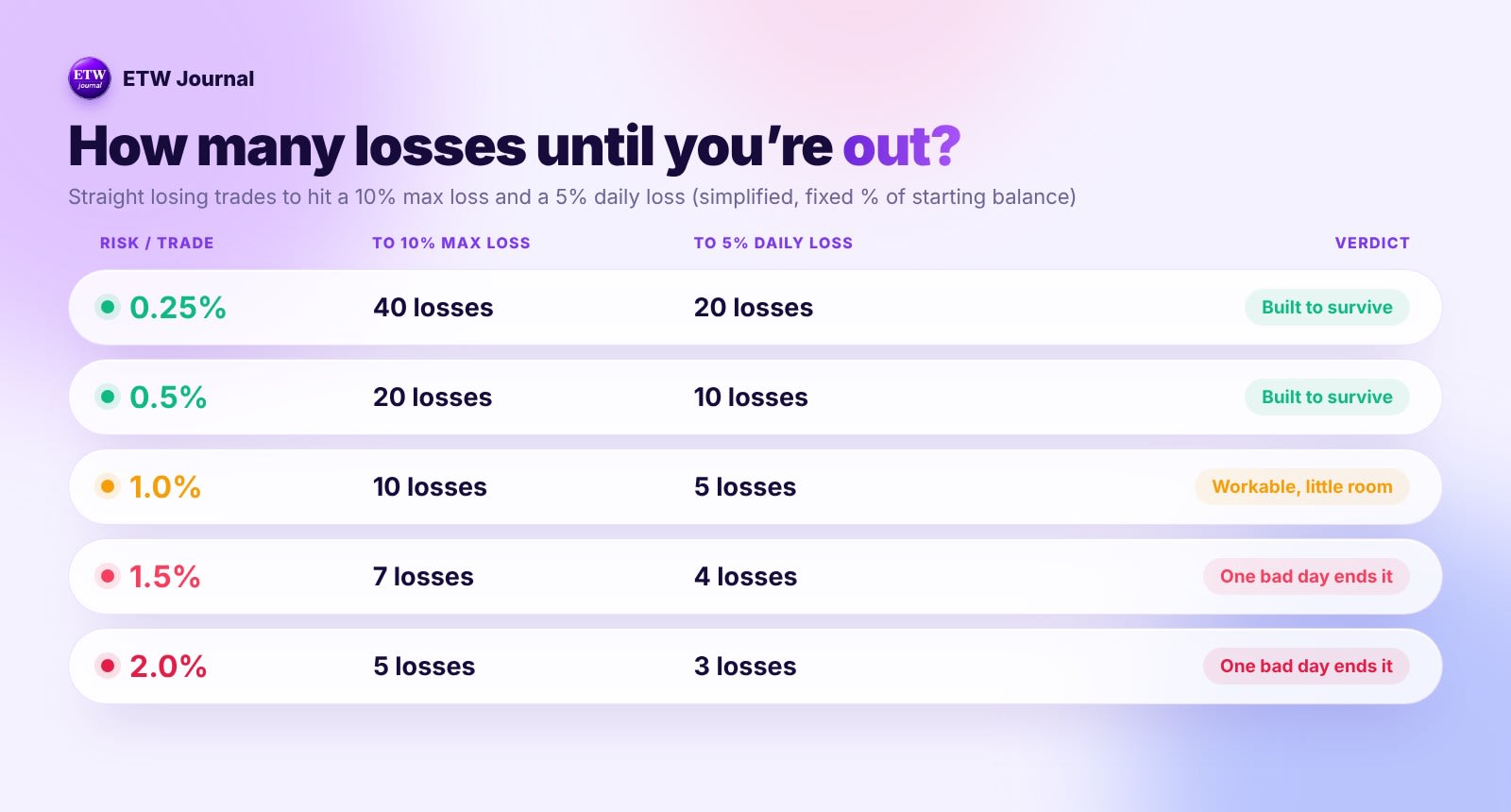
Losing streaks of 5 to 8 trades are normal for profitable traders over a few months. At 0.5% risk, a bad streak is an annoyance. At 2%, it's the end of your challenge.
Position sizing in one line
Lot size = (account × risk %) ÷ (stop loss in pips × pip value per lot)
Example: a $100,000 account risking 0.5% is $500. With a 20-pip stop on EUR/USD (about $10 per pip per standard lot): $500 ÷ (20 × $10) = 2.5 lots. Calculate this before every trade, not after.
How long passing really takes
Since none of these firms has a time limit on the standard 2-Step, there's no reason to rush. Here's roughly how many trades it takes to reach an 8% target at 0.5% risk with a 1:2 reward-to-risk:
| Win rate | Average result per trade | Trades to reach 8% | At 2 trades a day |
|---|---|---|---|
| 40% | +0.10% | ~80 trades | ~8 weeks |
| 45% | +0.175% | ~46 trades | ~5 weeks |
| 50% | +0.25% | ~32 trades | ~3 weeks |
| 55% | +0.325% | ~25 trades | ~2.5 weeks |
Three to eight weeks is a normal pace for a solid trader. If you're trying to pass in three days, you're not trading your edge. You're gambling with a fee.
A step-by-step plan to pass
- Know your numbers first. Before you buy, you should know your win rate, average R, worst losing streak and maximum drawdown from at least 50–100 journaled or backtested trades. If you don't, you're paying to find out.
- Match the model to your strategy. A swing strategy needs weekend holding. A scalper needs a firm with no harsh short-trade rules. A strategy with 7% historical drawdown doesn't belong in a 6% max-loss account.
- Set personal limits tighter than the firm's. If the firm allows 5% daily loss, your personal stop is 2–2.5%. If the max loss is 10%, treat 6% as your real floor.
- Risk 0.25–0.5% per trade. Increase only once you are well into profit, never to recover a loss.
- Limit trades per day. Two or three quality setups. After two losses in a row, you're done for the day.
- Plan each session. Check the economic calendar, mark your levels and write your game plan before the open.
- Stop when the target is hit. Once you reach the target and minimum days, stop. Extra trades only add risk.
- Review every week. Which setups, sessions and habits made money, and which cost you? Cut what doesn't work.
Once you're funded: keep the account
Passing is half the job. Funded accounts are where most of the "hidden" rules show up, so read the funded rules again: news restrictions, weekend holding, consistency rules for payouts and any minimum profitable days.
- Trade smaller, not bigger. Many traders halve their risk once funded. A slower month is better than losing the account.
- Respect consistency rules. FTMO's 1-Step, FundedNext's on-demand payouts, FundingPips' on-demand option and Maven all limit how much of your profit can come from a single day. Aim for many small green days, not one huge one.
- Withdraw regularly. Take payouts when you're eligible. Profit sitting in a simulated account isn't yours yet.
- Track your real result. Fees, resets and payouts across several firms add up. Know your true net, not just your best payout screenshot.
The 7 most expensive prop firm mistakes
| Mistake | Why it fails | The fix |
|---|---|---|
| Risking 1–2% to pass faster | A normal losing streak breaches the account | 0.25–0.5% per trade, no exceptions |
| Revenge trading after a loss | The daily limit goes in one emotional hour | Hard stop after two losses or a personal daily cap |
| Not reading the rules | Accounts breached on technicalities: news, weekends, quick trades | Read the full rules page before day one |
| Ignoring the server time zone | Daily reset happens mid-trade | Know your firm's reset time in your local time |
| Changing strategy mid-challenge | No data on the new approach | Trade only what you've tested and journaled |
| Buying a new challenge immediately after failing | Same mistakes, new fee | Review the failed account first, then decide |
| Spreading across too many firms | Different rules, divided focus, fees pile up | Master one or two firms' rules properly |
How ETW Journal helps you pass, and stay funded
Everything in this guide comes down to two things: knowing your numbers and following your rules. That's exactly what ETW Journal is built for.
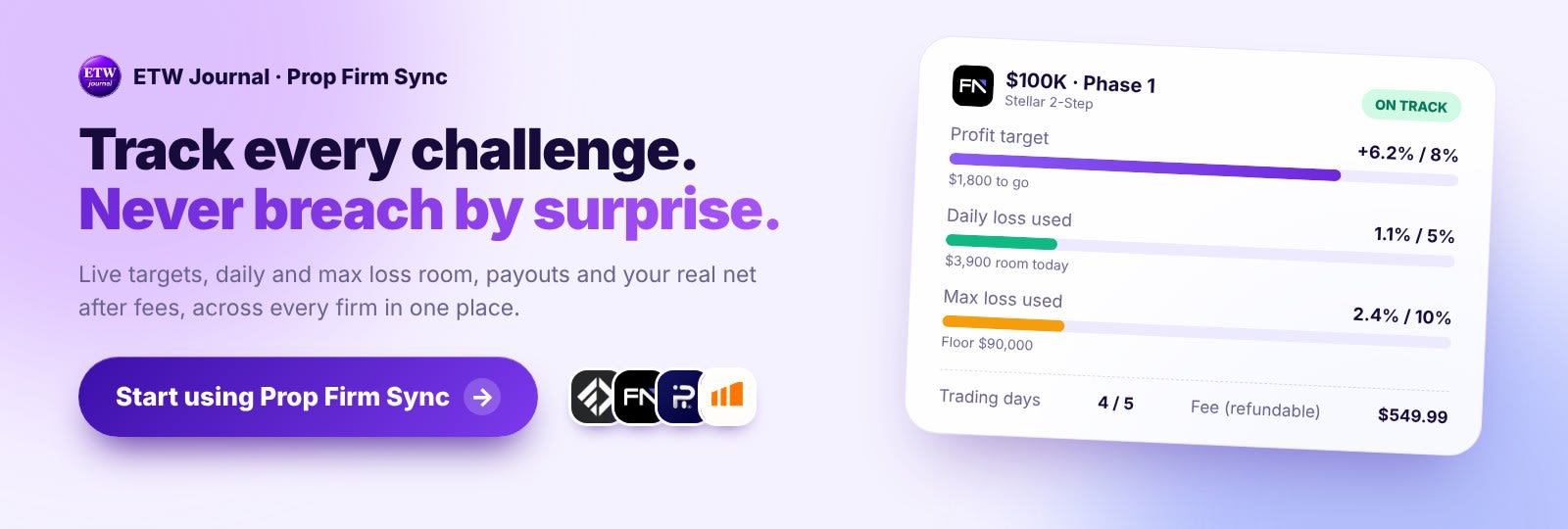
- Prop Firm Sync tracks every challenge, rule and payout, and shows your real net result after fees.
- Automatic sync from MT5 and cTrader means every trade is recorded, including the ones you'd rather forget.
- Session Prep gives you a pre-market game plan, an AI market sentiment briefing and an economic calendar in your own time zone, so news never catches you holding.
- The Discipline PnL Calendar scores your days on process: journaling, stop losses, risk and playbook rules, not just profit.
- Tags, playbooks and reports show which setups and sessions actually make you money before you pay for an evaluation.
And every month, our Monthly Winners journaling competition rewards the top two traders with prop firm accounts. Discipline is what we reward.
Frequently asked questions
Are prop firms legit?
Established firms like FTMO, FundedNext, FundingPips and Maven have paid traders publicly for years. But it's an unregulated industry in most places, firms change rules and some have closed suddenly. Never put more into fees than you can afford to lose, and withdraw profits regularly.
What account size should I start with?
Start with an account whose fee you can lose without it affecting your decisions. A $10K–$25K challenge with the same rules teaches the same lessons as a $200K one, for a fraction of the cost.
1-Step or 2-Step?
For most traders, 2-Step. The total target is higher but the daily and max loss limits are much more forgiving, and the drawdown is usually static rather than trailing.
Can I trade from Kenya?
Many Kenyan traders trade with major prop firms, but every firm keeps its own list of restricted countries and payment methods, and these change. Check the firm's FAQ before you buy.
Is passing a challenge the same as being profitable?
No. Passing proves you can follow rules for a few weeks. Being profitable means doing it for years. That's why the journal matters more than the certificate.
Prop firms aren't a shortcut to profits. They're a test of the habits that make a profitable trader: small risk, clear rules and honest review. Build those habits first, and the funded account follows.