 ETW

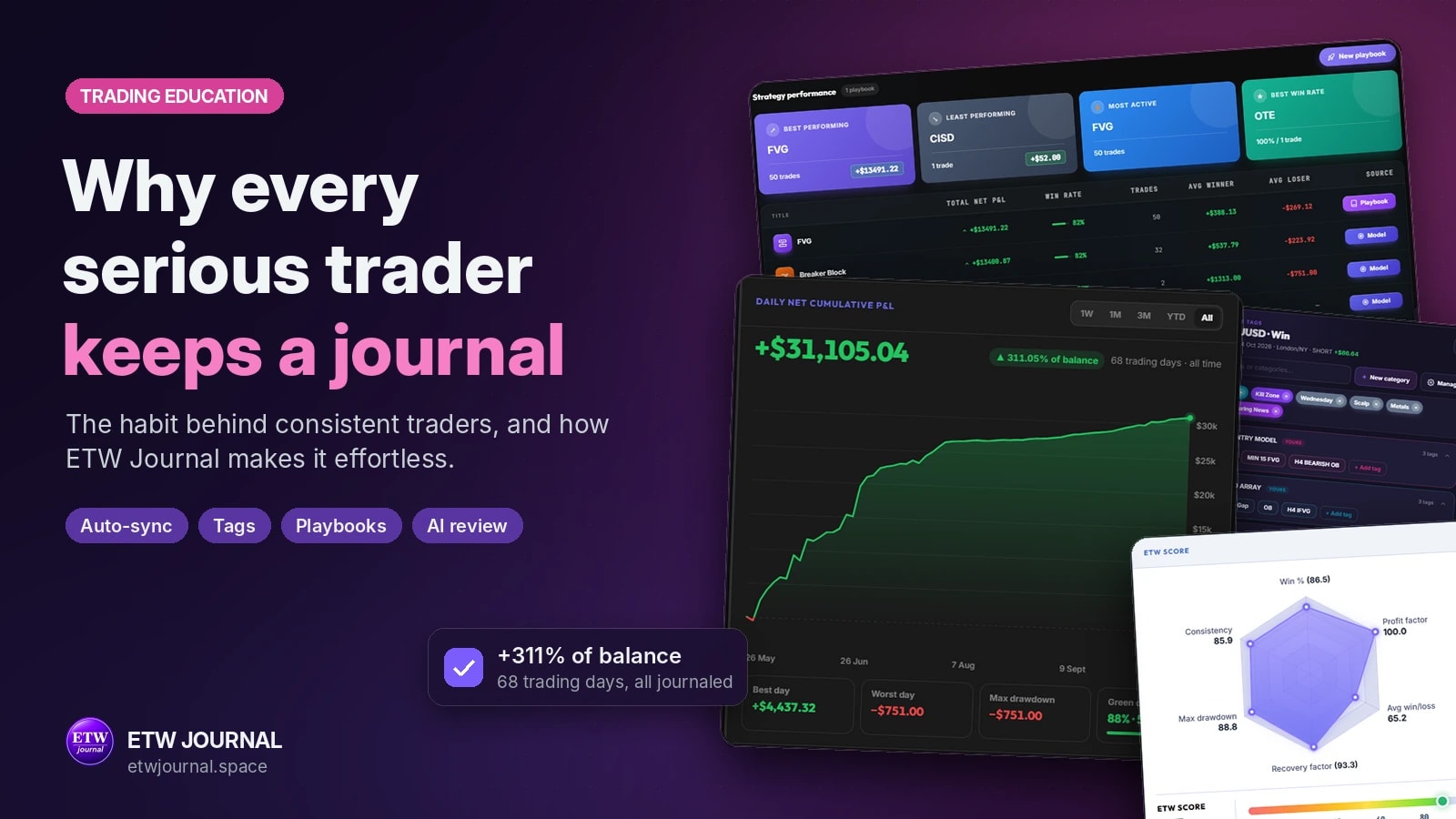
Most traders spend hundreds of hours looking for a better strategy and almost no time looking at the one thing they control completely: their own decisions. A trading journal fixes that. It turns every trade into data you can learn from, so you stop repeating the same mistakes and start doing more of what actually works.
This guide explains why journaling matters so much, what the research says about reflection, what to record, how to review it, which numbers to watch, and why ETW Journal makes the whole process close to effortless.
The uncomfortable numbers
Retail trading is hard. When Europe's markets regulator, ESMA, looked at retail CFD accounts across brokers, it found that 74–89% of retail accounts typically lose money. A long-running academic study of day traders in Taiwan by Brad Barber, Terrance Odean and colleagues found that only around 13–15% earned a profit after fees in a typical year, and fewer than 1% could predictably beat the market year after year.
The minority who last don't share a single magic indicator. What they share is a feedback loop: they record what they do, review it honestly and adjust. That loop is a trading journal.
A strategy tells you what to do. A journal tells you what you actually did, and whether it worked. You need both.
What a trading journal really is
A journal isn't a list of profits and losses; your broker statement already does that. A real journal records the decision behind each trade:
- The setup: what you saw and why you took it.
- The context: market, session, timeframe, news.
- The plan: entry, stop, target and risk before you clicked.
- The execution: did you follow the plan, or improvise?
- Your state: calm, rushed, revenge, bored, confident?
- The outcome: P&L, R-multiple and what you learned.
Collect that for enough trades and patterns appear that you'd never notice from memory.
Why journaling works: the science of reflection
In a Harvard Business School study, researchers Giada Di Stefano, Francesca Gino, Gary Pisano and Bradley Staats asked new employees at an outsourcing company to spend 15 minutes at the end of each training day writing down lessons learned. After ten days, that group scored about 23% higher on the final assessment than colleagues who simply kept practising. The researchers' conclusion: experience becomes learning when you deliberately reflect on it.
Trading magnifies this effect because our memory of trades is badly biased:
- Recency bias: last week's losses feel like your whole track record.
- Confirmation bias: you remember the trades that proved you right.
- Hindsight bias: after the fact, every move "was obvious".
- Outcome bias: a bad trade that won feels like a good trade; a good trade that lost feels like a mistake.
A journal replaces those feelings with evidence. Instead of "I think London is my best session", you know your win rate, profit factor and average R for London versus New York.
9 ways a journal makes you a better trader
1. It shows you your real edge
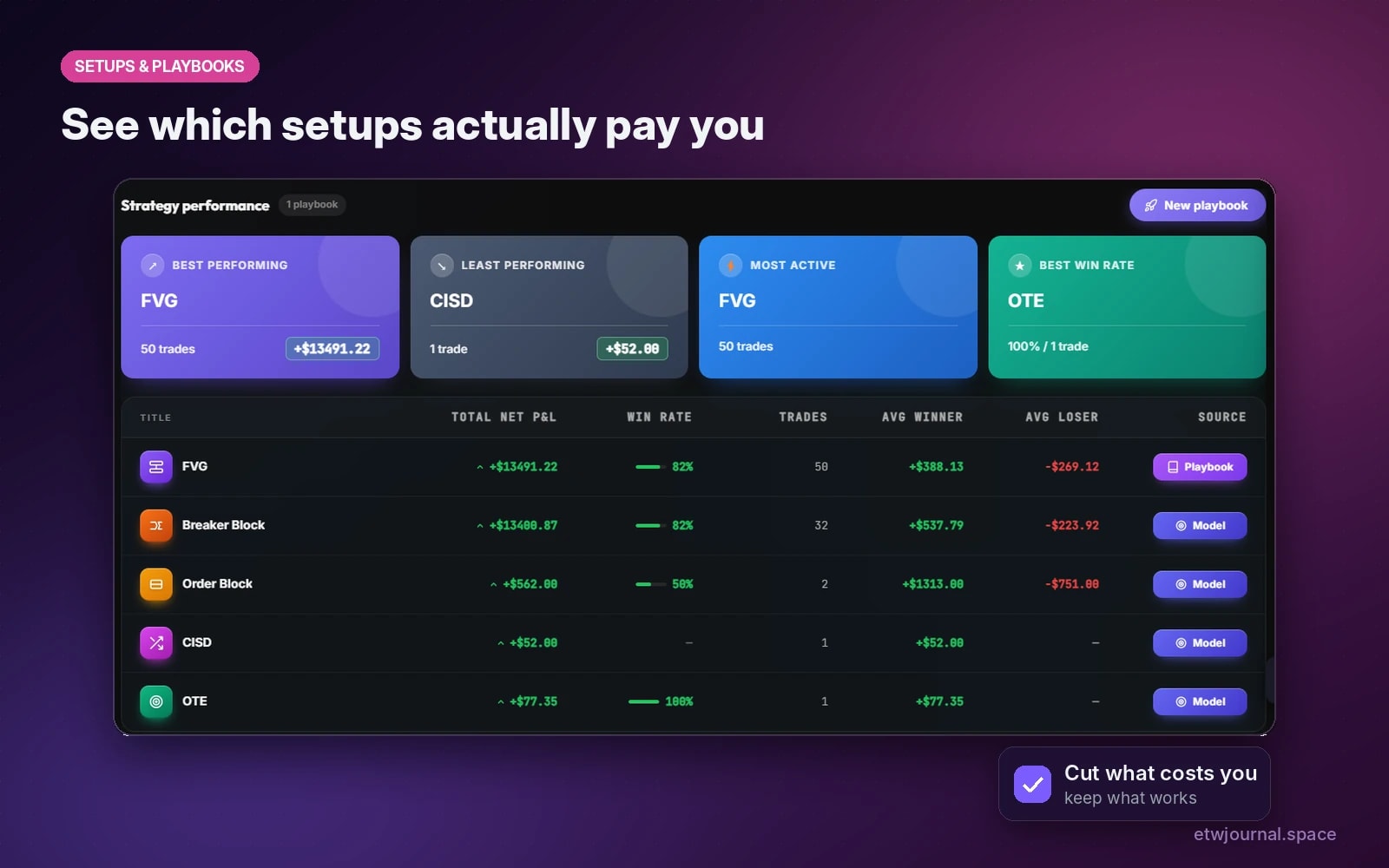
Most traders run three or four setups and assume they all work. Tag every trade with its setup and the numbers often disagree. In the example above, two setups produce almost all the profit, and the others barely move the needle. That tells you exactly where to focus your screen time and your risk.
2. It exposes your leaks
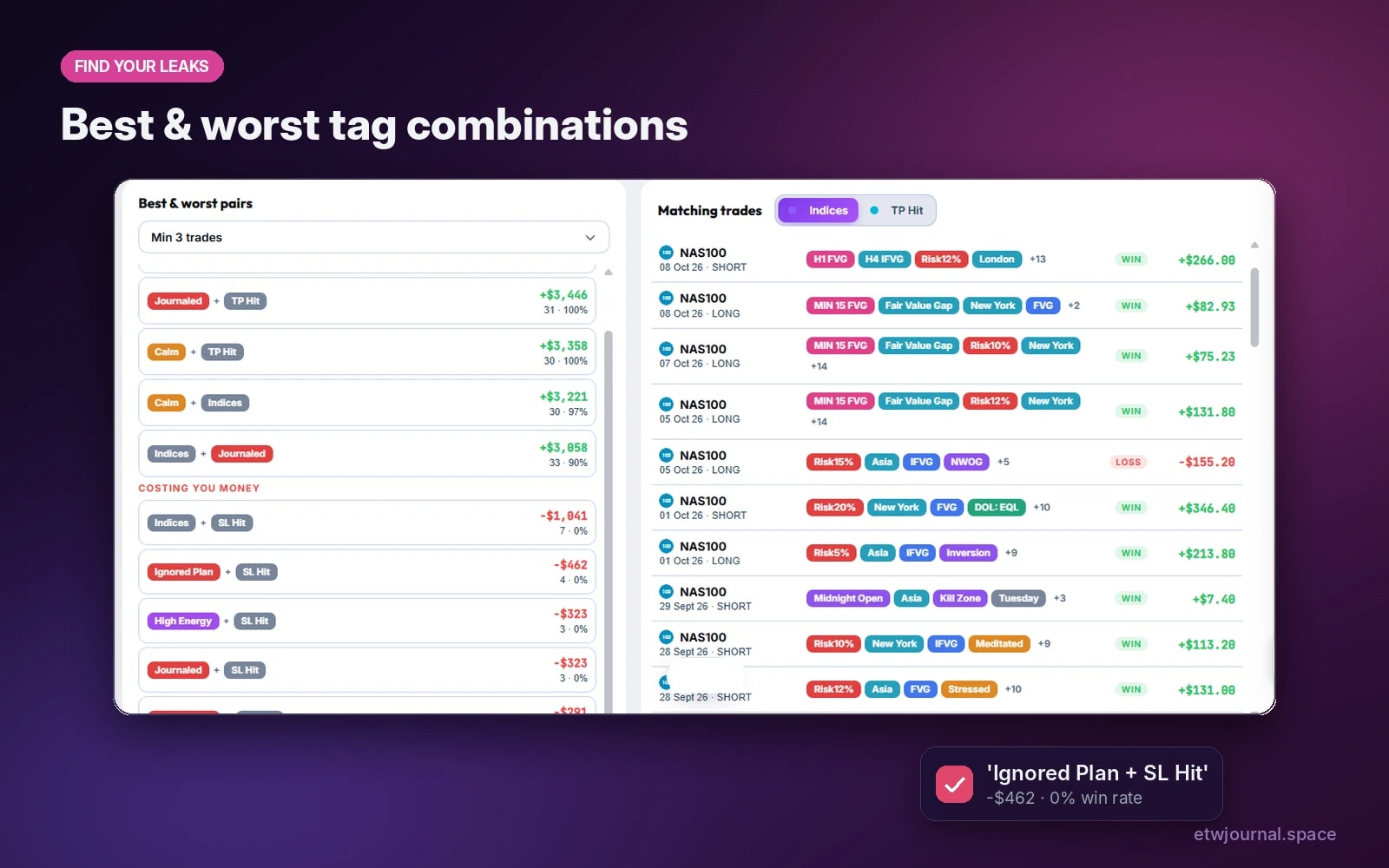
Losses rarely come from one big mistake. They come from repeated small ones: entering without a plan, sizing up when stressed, trading through news. When you tag trades with behaviours as well as setups, combinations like "Ignored Plan + SL Hit" jump out with a 0% win rate. Once you can see a leak, you can plug it.
3. It tells you when to trade (and when not to)
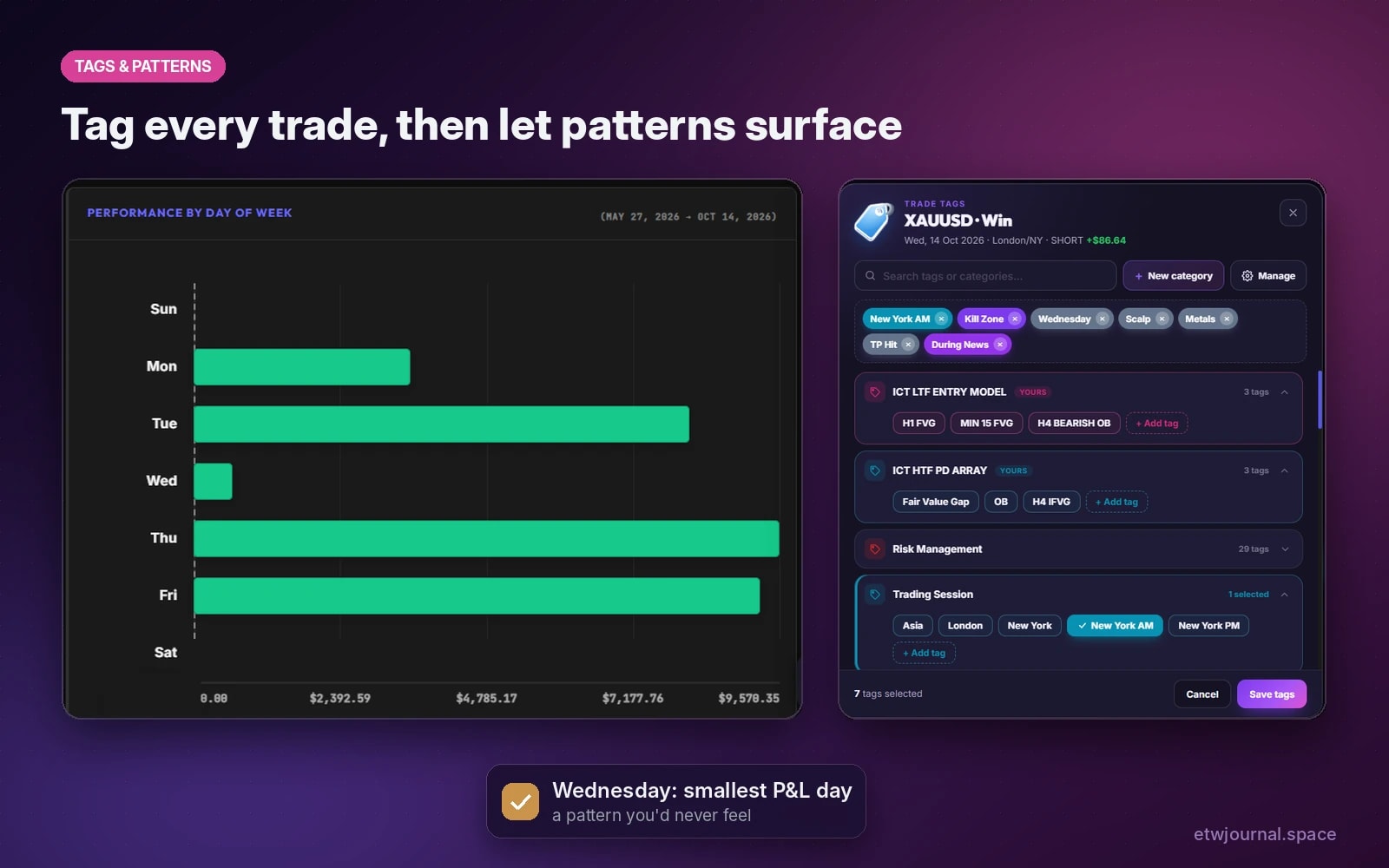
Many traders find that one day of the week or one session produces most of their losses. In the chart above, Wednesday barely contributes while Thursday and Friday do the heavy lifting. Knowing that, you can trade smaller, or not at all, during your weakest windows.
4. It turns your rules into something you actually follow
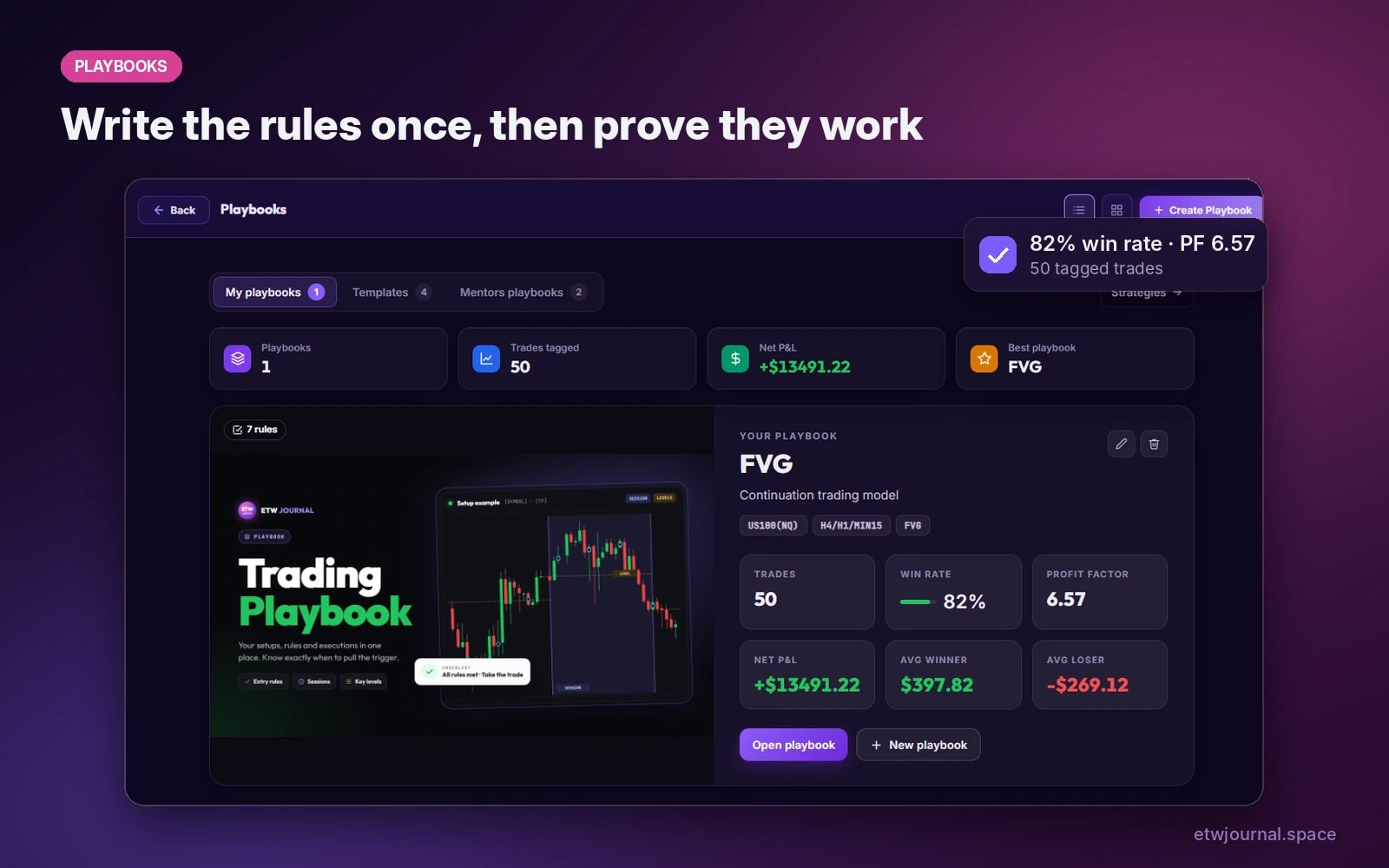
Writing rules is easy; following them under pressure isn't. A playbook with a checklist attached to each trade shows your follow rate for every rule, and lets you compare trades where you followed the plan with trades where you didn't. When the data shows that rule-breaking trades lose money, discipline stops being a vague goal and becomes a number you want to protect.
5. It makes risk visible
Your equity curve, maximum drawdown and average loss tell you whether your risk per trade is sustainable. A journal makes those numbers impossible to ignore, which is exactly what you need before a losing streak turns into a blown account.
6. It helps you master your emotions
Tag your emotional state on each trade (calm, stressed, revenge, FOMO, high energy) and you'll often find that the same strategy has a completely different win rate depending on your mood. That's not a strategy problem; it's a routine problem, and you can fix it.
7. It measures discipline, not just profit
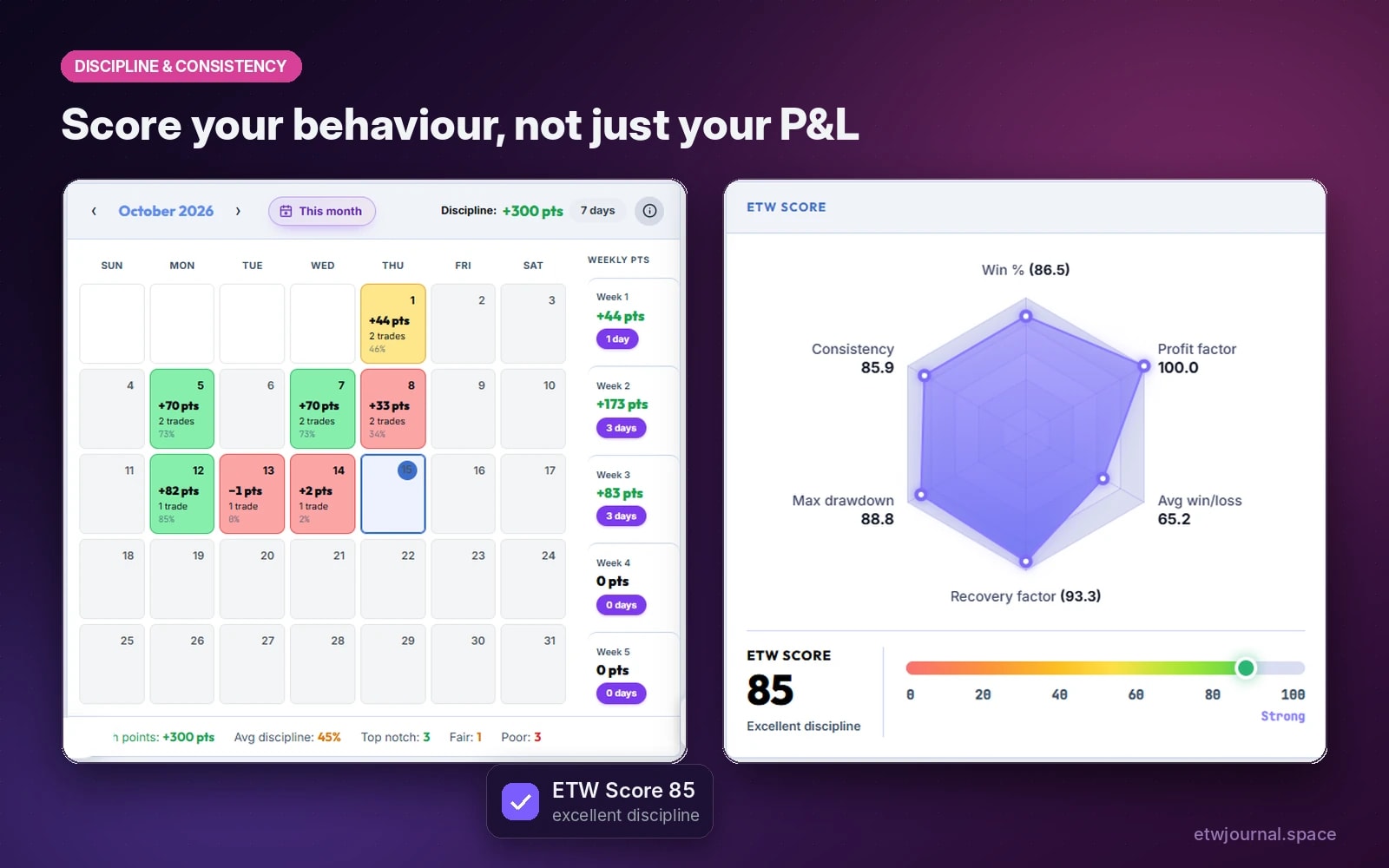
A profitable day where you broke every rule is a warning. A losing day where you followed your plan perfectly is a success. Scoring your discipline separately from your P&L teaches you to reward the process, which is the only thing that compounds.
8. It's how traders pass prop firm challenges
Challenges are rarely failed because of the strategy. They're failed because of rule breaks: overtrading after a loss, sizing up to recover, trading outside your best sessions. A journal shows you those habits during the challenge, while there's still time to stop them.
9. It speeds up learning and accountability
When a mentor or trading partner can see your actual trades instead of screenshots and memories, their feedback gets specific. You also build a searchable library of your own best and worst trades, which beats any course for teaching you how you trade.
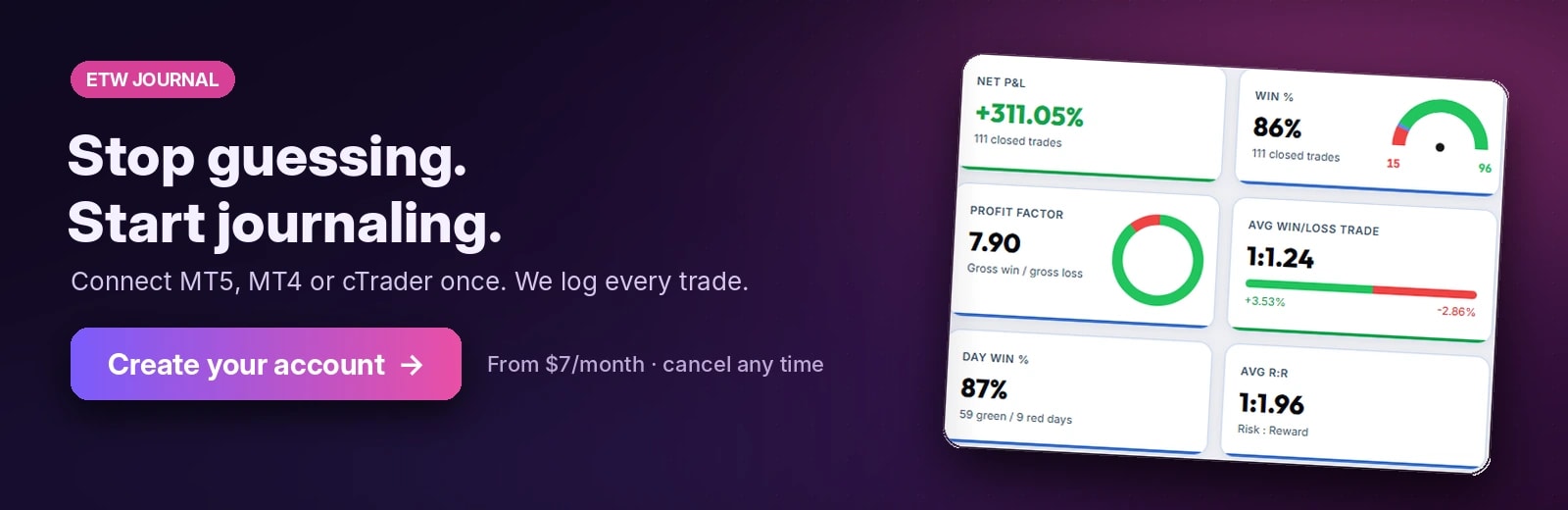
Create your ETW Journal account →
What to record for every trade
Keep it consistent. A good minimum:
- Date, time and session
- Instrument and direction
- Entry, stop-loss, take-profit and position size
- Risk in money and in % of the account
- Setup or model (for example FVG, order block, supply and demand)
- Timeframes used for bias and for entry
- Reason for entry, in one or two sentences
- Whether you followed your plan (yes, partly or no)
- Emotional state before and after
- Result: P&L, R-multiple, and whether the stop or target was hit
- A chart screenshot and one lesson
Write the reason for entry before you see the outcome. Your notes stay honest, and you can later judge the decision on its own merits.
How to review: a simple routine
- After each session (5–10 minutes): check that every trade is tagged, add notes and screenshots, and write one sentence on what went well and one on what to improve.
- Weekly (30–45 minutes): compare setups, sessions and days. Look at rule breaks and at your biggest win and biggest loss. Pick one thing to change next week.
- Monthly: review your equity curve, drawdown, profit factor and expectancy. Retire setups that don't pay, and give more attention to the ones that do.
Be patient with the numbers. Judge a setup on at least 30–50 trades, not five. Small samples lie.
The numbers every journal should show you
- Win rate: the percentage of trades that win. On its own, it means little.
- Average win vs average loss: the size of a typical winner compared with a typical loser.
- R-multiple: profit or loss measured in units of the risk you took.
- Profit factor: gross profit divided by gross loss. Above 1 means you're making money; many traders aim for 1.5 or more.
- Expectancy: what you make per trade on average, in R.
- Maximum drawdown: the deepest drop from a peak, your real-world risk.
- Consistency: how evenly profits are spread across days, rather than coming from one lucky trade.
A quick expectancy example: with a 45% win rate, an average win of 2R and an average loss of 1R, expectancy is (0.45 × 2) − (0.55 × 1) = +0.35R per trade. Risking 1% per trade, that's roughly +3.5% per 10 trades on average, even though you lose more often than you win. Only a journal can give you these numbers for your trading.
Why most traders quit journaling
If journaling is this powerful, why doesn't everyone do it? Because the traditional way is tedious:
- Copying every trade from MT5 into a spreadsheet takes minutes per trade.
- Formulas break, time zones don't match, and partial closes get messy.
- Stats like profit factor by session need pivot tables most traders never build.
- Notes and screenshots end up scattered across apps and folders.
When journaling feels like admin, it's the first habit to go after a bad week, which is exactly when you need it most. The answer is to remove the admin.
Why ETW Journal is built for this
ETW Journal was designed around one idea: the journal should fill itself, so all your energy goes into the review.
Your trades log themselves
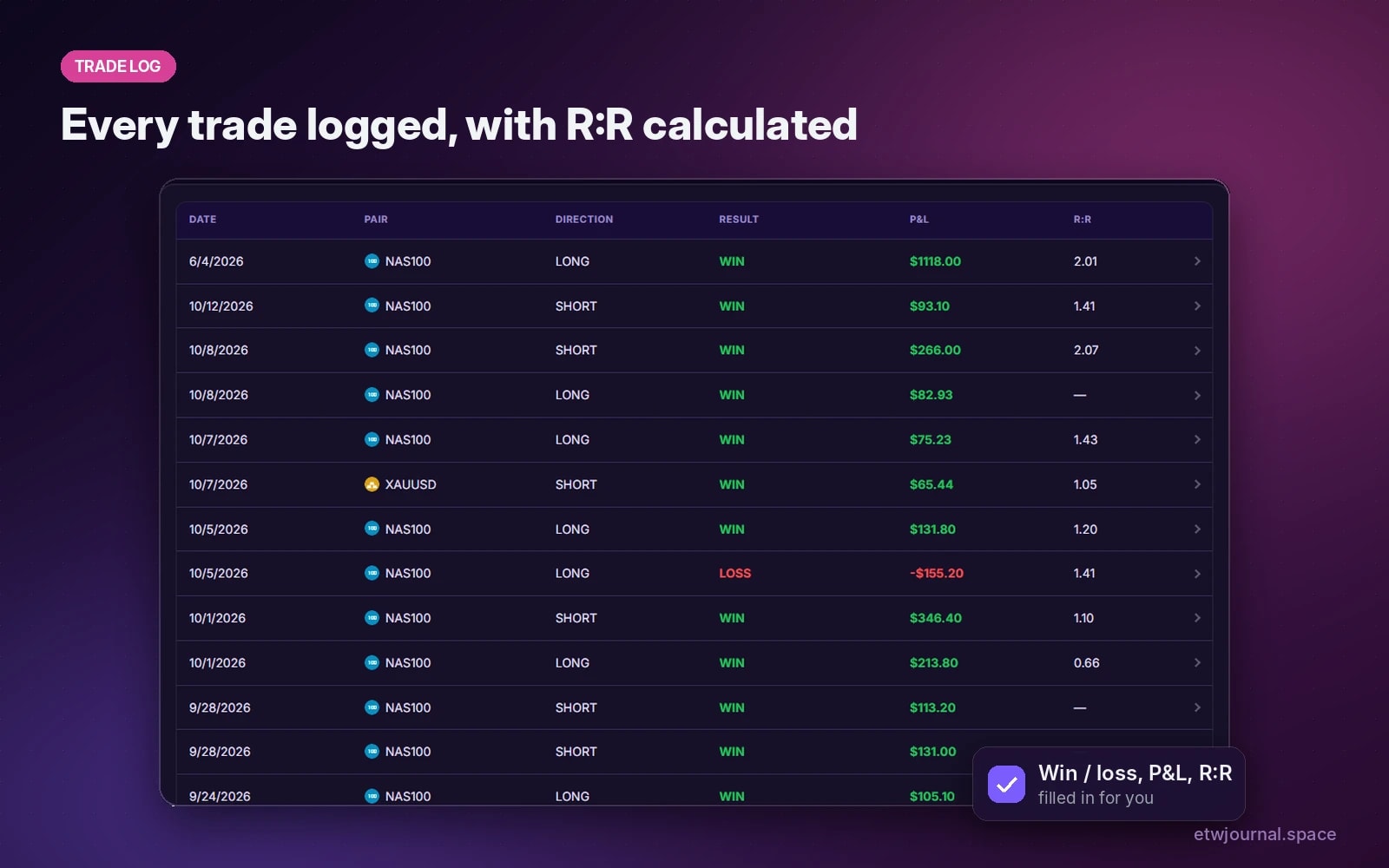
Connect MetaTrader 5, MetaTrader 4, cTrader, TradeLocker or DXtrade once. ETW Journal imports your full available history, then keeps syncing new trades. Connections are read-only: ETW can see your history but can never place trades or move funds. You can still add trades by hand, with R:R, pips, points and ticks calculated for you.
Your stats build themselves
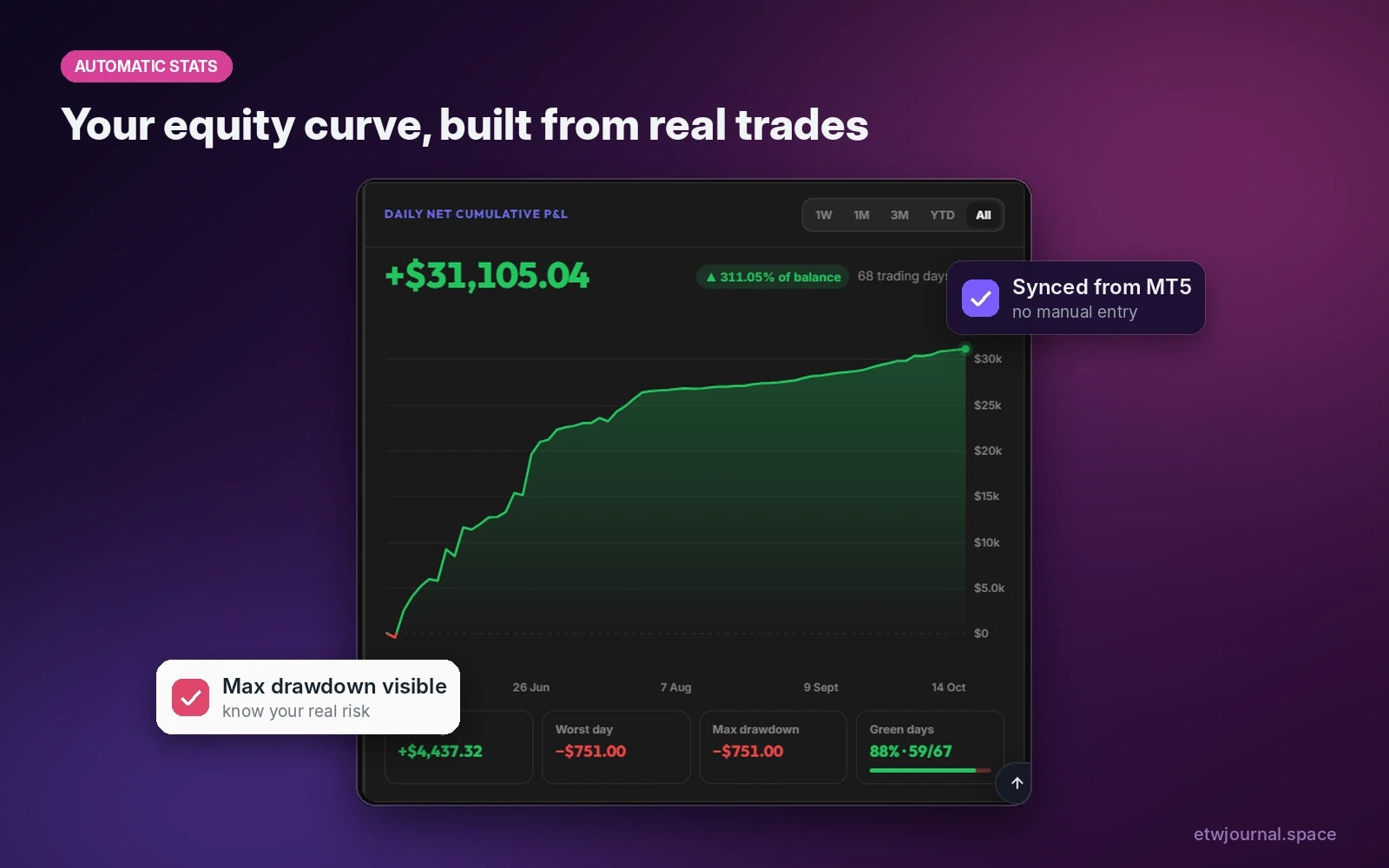
Net P&L, win rate, profit factor, average win/loss, drawdown, streaks and a colour-coded P&L calendar are ready from day one. Reports break everything down by instrument, month, weekday and rule compliance.
Tags, Tag Lab and the category tracker
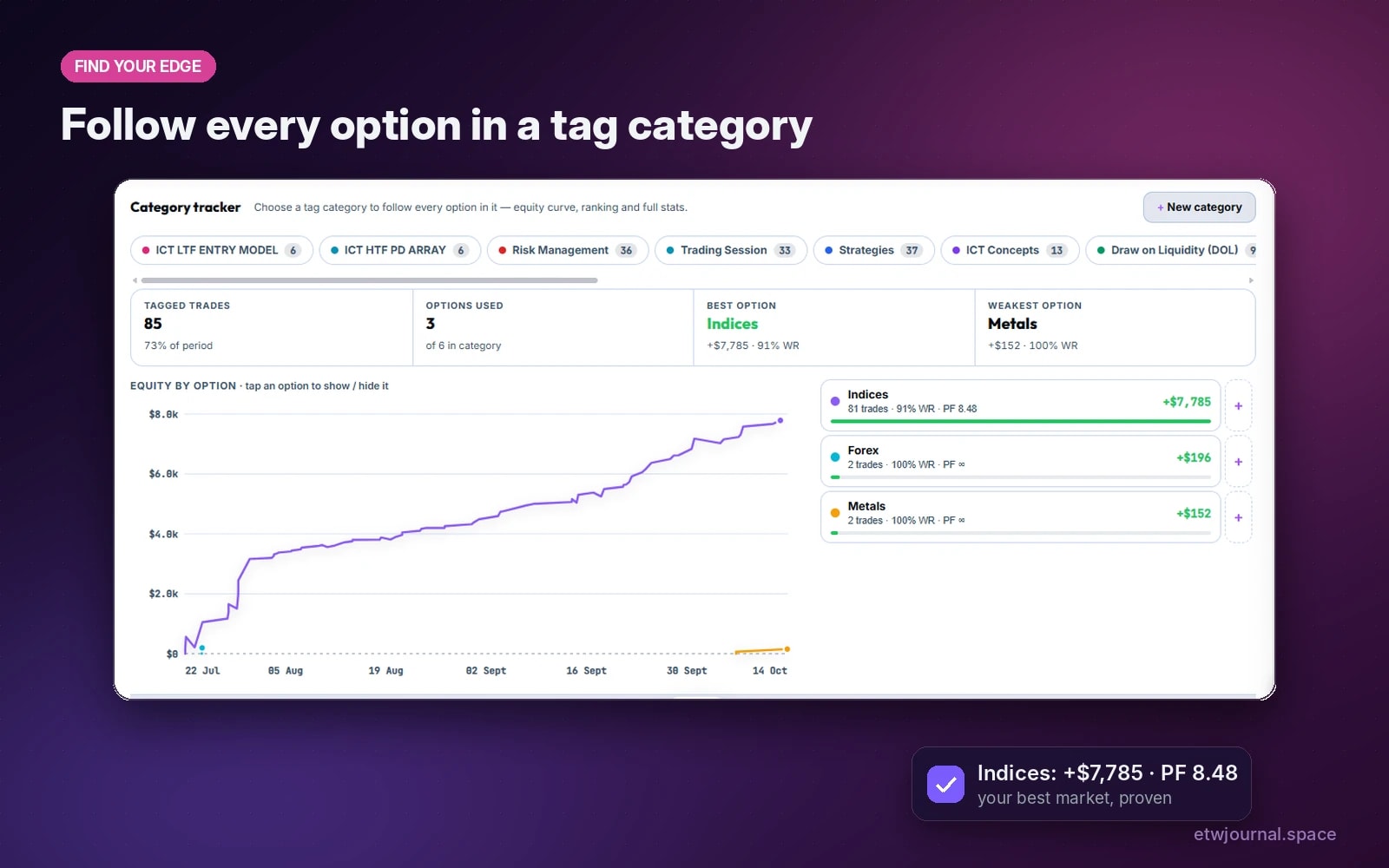
Create your own tag categories for setups, sessions, risk, emotions or anything else, tag trades in seconds, then compare options side by side on one equity curve. Best and worst tag pairs show which combinations of habits make you money and which cost you.
Everything else a serious trader needs, in one place
- Playbooks with rule checklists, follow rates and per-strategy stats, plus playbooks from ETW mentors to learn from.
- Discipline calendar and ETW Score to track behaviour, not just profit.
- ETW AI that answers questions from your own trades and notes, like "What is my biggest weakness right now?"
- Trade replay to relive executed trades bar by bar with your real entries, stops and targets.
- Backtesting to practise setups on historical data with risk-based sizing.
- Prop Firm Sync to track challenges, funded accounts, fees and payouts, with every synced trade checked against your firm's rules.
- Mentor Mode and ETW University so mentors can review your real journal and help you improve.
- Economic calendar in your own time zone, so news never catches you off guard.
Plans start at $7 a month (Essential) and $15 a month (Pro), with savings on quarterly and yearly billing. Still deciding? See how ETW compares with Notion and Excel & Google Sheets.
Get started in five minutes
- Sign up with Google or email at etwiz.space.
- Connect your MT5, MT4, cTrader, TradeLocker or DXtrade account. Your history imports automatically.
- Create two or three tag categories: setup, session and emotion are a great start.
- Write a simple playbook for your main setup with five to seven rules.
- Block 10 minutes after every session and 30 minutes every weekend for review.
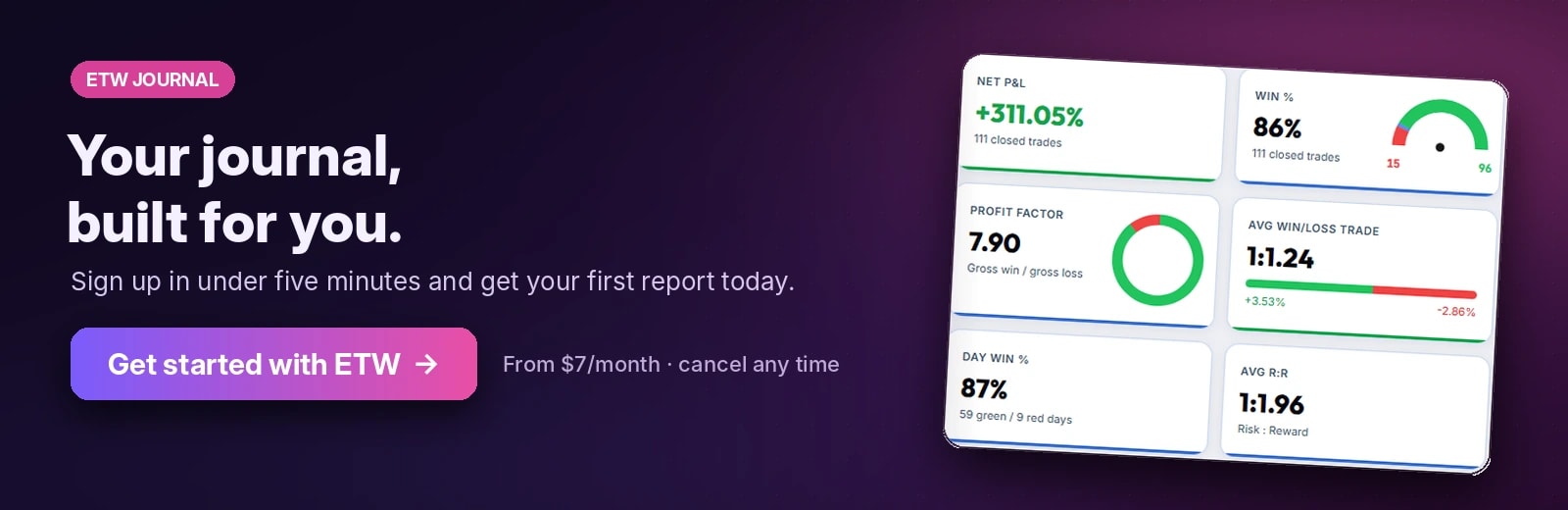
Get started with ETW Journal →
Frequently asked questions
How long before journaling shows results?
Many traders spot their first clear leak within two to four weeks. Reliable conclusions about a specific setup usually need 30–50 trades of that setup.
Should I journal my demo or backtest trades too?
Yes, but keep them separate from live trades. In ETW Journal, each account and each backtesting session has its own stats, so you can compare practice with real execution.
Is journaling worth it if I only take a few trades a week?
Even more so. With fewer trades, every lesson matters, and a journal stops you from drawing big conclusions from small samples.
What if I hate writing notes?
Let automation handle the numbers and keep notes short: one line on why you entered and one on what you learned. Tags do most of the work.
Key takeaways
- Most retail traders lose money; the ones who improve have a feedback loop.
- Reflection turns experience into learning. In the Harvard study, 15 minutes a day lifted performance by about 23%.
- Record decisions, context and emotions, not just P&L.
- Review daily, weekly and monthly, and judge setups on meaningful sample sizes.
- Remove the admin, and journaling becomes a habit that sticks. That's what ETW Journal is built for.
This article is for education only and isn't financial advice. Trading forex, CFDs and other leveraged products carries a high risk of loss.
Sources: ESMA (2018), "ESMA agrees to prohibit binary options and restrict CFDs to protect retail investors"; Barber, Lee, Liu and Odean, "The Cross-Section of Speculator Skill: Evidence from Day Trading" (UC Berkeley); Di Stefano, Gino, Pisano and Staats, "Learning by Thinking: How Reflection Aids Performance" (Harvard Business School Working Paper 14-093).